Top Signs a Pre-Owned Vehicle Has Been Well Maintained
Key Insights -The overall comprehensive maintenance record from a shop or single dealership would be preferable, showing evidence of proper car...
Read more
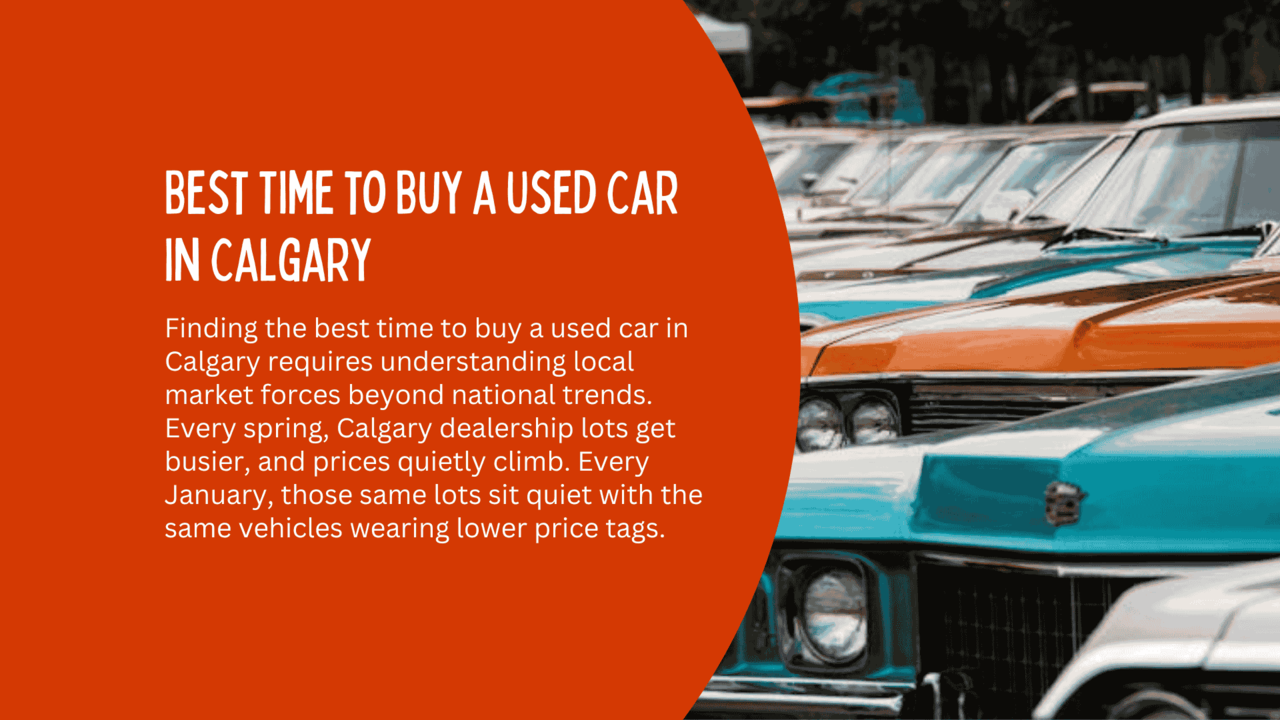
Finding the best time to buy a used car in Calgary requires understanding local market forces beyond national trends. Every spring, Calgary dealership lots get busier, and prices quietly climb. Every January, those same lots sit quiet with the same vehicles wearing lower price tags. But here's what most guides won't tell you: timing a used car purchase in Calgary is not as simple as "wait for winter."
Calgary has its own rules. The purchasing environment created by the Chinook wind cycle, Alberta's no-PST tax structure, and AMVIC licensing protections is entirely absent from national car guides. The honest response to the question of whether to purchase before or after winter is that it depends on which benefit is more important to you. It is explained in detail in this guide.
Most buyers assume car prices follow a single national pattern. In Calgary, that assumption will cost you money.
Calgary's used car market runs on five local forces that most guides ignore. Understanding them is the first step to finding the best time to buy a used car in Calgary for your specific situation.
|
Key Takeaway: Calgary's no-PST advantage, energy-sector demand cycles, and Chinook corrosion risk all affect used car pricing and inspection needs, making local knowledge worth more than any national buying guide. |
The best time to buy a used car in Calgary is between late October and February. Dealers cut prices to meet year-end quotas, demand declines, and private sellers scramble to sell before winter arrives. At AMVIC-licensed dealerships, prices are usually 5 and a half dollars, which is 10% less than peak spring demand, and there is more room for negotiation.
Here's the part most guides miss entirely. October and November are not just cheap; they are strategically undervalued. Private sellers in Calgary rush to offload vehicles before the road salt season starts. They want to avoid winter storage costs, upcoming maintenance bills, and the hassle of showing a car in cold weather. That seller psychology creates motivated pricing you simply cannot find in April.
The worst time to buy is March through April. Tax refund season pushes demand sharply upward. Prices recover fast. Buyers who waited all winter for spring often pay more than they would have in November. Late August is also a competitive back-to-school demand for compact and family vehicles, creating a second demand spike.
One crucial detail is that AMVIC-licensed dealerships, such as Autos House Calgary, keep controlled, inspected inventory all year long. Purchasing a safe car from a licensed dealer does not require you to wait for any particular seasonal window. Price and negotiating power have a greater influence on the seasonal advantage than protection or availability. Wait for any specific seasonal window to buy a safe car from a licensed dealer. The seasonal advantage is more related to price and negotiating power than availability or protection.
Source: Canada Drives seasonal pricing analysis, 2025; AMVIC consumer rights documentation, amvic.org.
|
Key Takeaway: Late October through February is the strongest buying window in Calgary, not just because dealer prices drop, but because private seller psychology creates motivated pricing that peaks in November and December. |
Knowing the best month is useful. Knowing how each season compares gives you a full-year strategy, whether you are buying now or planning ahead.
|
Season |
Price Level |
Inventory |
Negotiation |
Best Buy For |
|---|---|---|---|---|
|
Fall (Oct–Nov) |
Low |
HIGH |
Strong |
AWD, Trucks |
|
Winter (Dec–Feb) |
Lowest |
Medium |
Strongest |
Inspect carefully |
|
Spring (Mar–May) |
Rising |
High |
Moderate |
All types |
|
Summer (Jun–Aug) |
High |
High |
Weakest |
Unsold spring stock |
Fall (October–November) is the sweet spot. Trade-in volumes from summer are high, which means dealer inventory is strong. Dealers are motivated before year-end. Private sellers are listing before the first snowfall. You get selection and leverage simultaneously, a rare combination.
Winter (December–February) delivers the lowest prices, but December is the standout month. Year-end quota pressure pushes sales managers hard. January is underrated. Foot traffic is minimal, inventory has not moved, and motivation to deal is genuine. February starts to see prices edge back up.
Spring brings a fast recovery. Tax refund season arrives in March and drives demand sharply upward. If you are shopping in April and expecting winter-level pricing, you will be disappointed. The window closes quickly.
Summer pricing peaks in June and July. If you must buy in summer, target vehicles that have sat unsold since spring; dealers are more flexible on aged stock regardless of season.
|
Key Takeaway: In Calgary, fall and winter give you the strongest combination of lower prices and negotiating power. Spring and summer favor the seller. |
Here is information that no national car-buying guide will give you because it only applies to Calgary.
A Chinook is a warm, dry wind that hits the Calgary region during winter and rapidly raises temperatures. Environment and Climate Change Canada documents Chinook events in the Calgary-Lethbridge corridor where temperatures can rise 20°C or more within a single day. This freeze-thaw cycle is not gradual. It is abrupt, repeated, and hard on vehicles.
For used car buyers, this creates a specific risk. Metal expands and contracts with each temperature swing. Underbody components, frame rails, brake lines, exhaust hangers, and suspension brackets experience stress that steady-cold cities like Regina or Winnipeg never produce. A vehicle that wintered in Calgary for three years may carry corrosion that a car from Edmonton simply does not.
There is a second, more immediate problem. A test drive conducted on a warm Chinook day when roads are clear, and temperatures are above zero will not reveal the same issues as a cold-start test drive at -15°C. Sellers know this. They will often suggest you come view the car on a milder day. You should insist on a cold-start assessment.
One more layer of protection: an AMVIC-licensed dealership in Alberta is legally required to disclose known material defects. According to Alberta law, private sellers are not required to do so.
There is true consumer protection when a Chinook winter can conceal damage due to slush and mild temperatures. This legal distinction is more than just a technicality.
Source: Albertas AMVIC Act, 2025
|
Key Takeaway: Calgary's Chinook cycle creates corrosion and inspection risks that no other Canadian city produces. Always request an independent pre-purchase inspection and buy from an AMVIC-licensed dealer for mandatory defect disclosure protection. |
Knowing winter is cheaper is the starting point. Stacking multiple timing advantages simultaneously is how you find real savings on used car prices in Calgary.
The three independent variables that drive dealership pricing in your favor are: season, month-end, and year-end quota pressure. When all three align, your negotiation position is as strong as it gets.
|
Key Takeaway: The maximum savings window for used car prices in Calgary is the last week of November or December, where low-season demand, month-end quotas, and year-end targets all align at once. |
|
Every vehicle at Autos House Calgary is AMVIC-inspected with transparent pricing. No hidden Chinook-damage surprises. No private-seller risk. → View Our AMVIC-Certified Inventory |
Most buyers do a quick walk-around and a short test drive. In a Calgary winter, that is not enough.
The combination of road salt, freeze-thaw Chinook cycles, and cold-start stress creates specific failure points that only surface under the right inspection conditions. Here is what to check and why each item matters more in Calgary than anywhere else in Canada.
Importantly, even experienced buyers miss underbody damage without a lift inspection. A $165 inspection on a $15,000 vehicle is a 1.1% insurance cost. It is always worth it in Calgary's winter market.
|
Key Takeaway: In Calgary winter, a cold-start test drive plus an independent underbody inspection are non-negotiable. Chinook freeze-thaw cycles create corrosion risks that a standard walk-around will never reveal. |
Winter is the riskiest season to buy from a private seller in Calgary. Here is exactly why and what the difference costs you if something goes wrong.
Under the AMVIC Act (Alberta Motor Vehicle Industry Council), licensed dealerships must disclose all known material defects before sale. They must also carry liability insurance and comply with regulated inspection standards. Private sellers operate under no equivalent obligation. They can sell you a car with known issues and face no regulatory consequence. Source: AMVIC Act, Alberta, 2025 revision.
In winter, this gap matters more than in any other season. Snow, slush, and Chinook-cycle mud can conceal frame damage, underbody rust, and bodywork repairs that would be immediately visible in summer. A private seller listing in November is often motivated, which is good for pricing, but that motivation may reflect a known problem they want to offload before spring inspection conditions return.
|
Factor |
Private Seller |
AMVIC-Licensed Dealer |
|---|---|---|
|
Defect Disclosure |
No legal obligation |
Mandatory under the AMVIC Act |
|
Winter Inspection |
Seller's word only |
Documented pre-sale inspection |
|
Financing Options |
Cash only (typically) |
Flexible financing available |
|
Warranty Coverage |
None |
Dealer or 3rd-party warranty |
|
Dispute Resolution |
Small claims court |
AMVIC consumer complaint process |
|
Year-End Negotiation |
Often motivated |
Quota-driven strong leverage |
The practical takeaway: private sellers can offer attractive pre-winter pricing. If you go that route, make an independent inspection a non-negotiable condition of purchase. For most buyers, the combination of winter pricing, AMVIC protection, financing flexibility, and warranty coverage makes a licensed dealership the stronger choice, especially in Calgary's challenging inspection season.
|
Key Takeaway: In Calgary winter, the legal protection gap between AMVIC-licensed dealers and private sellers is at its widest because seasonal conditions actively conceal the defects that disclosure rules are designed to surface. |
The answer to whether you should buy before or after winter in Calgary is not a single date on a calendar. It is a set of advantages that stack differently depending on your priorities.
If your priority is price, buy in late October through February, specifically in the last week of November or December. You get low-season demand, month-end quota pressure, and year-end targets all working in your favor simultaneously. Alberta's no-PST structure adds structural savings on top.
Regardless of the season, purchase from an AMVIC-licensed dealership if protection is your top priority. In a city where a Chinook can conceal significant vehicle damage on a day of mild weather, the disclosure requirements, inspection standards, and consumer complaint procedure offer a safety net that no private sale can match.
At Autos House Calgary, our inventory is AMVIC-licensed, inspected, and priced transparently year-round. Whether you are shopping in November to catch the pricing window or in March because life simply demands a car, you will find vehicles that have been assessed for Calgary's specific winter conditions.
|
Ready to find your next used car in Calgary? Browse Autos House Calgary's full AMVIC-licensed inventory, AWD, 4x4, and winter-ready options available now. We offer transparent pricing with no hidden fees, available year-round.. → Browse Inventory → Contact Us Today |
What is the best time to buy a used car in Calgary?
Late October through February are the best months to purchase a used car in Calgary. Dealers cut prices to meet year-end quotas, private sellers rush to sell before winter, and demand is at its lowest. Typically, prices are 10% less than peak spring.
In addition to the financial benefit, purchasing from an AMVIC-licensed dealer during this window offers legal consumer protections. Late October through February are the best months to purchase a used car in Calgary. Dealers cut prices to meet year-end quotas, private sellers rush to sell before winter, and demand is at its lowest. Typically, prices are 10% less than peak spring.
In addition to the financial benefit, purchasing from an AMVIC-licensed dealer during this window offers legal consumer protections.
Do used car prices drop in winter in Alberta?
Yes. Calgary dealerships see a decrease in customer traffic during the winter, which encourages discounting and more aggressive bargaining. December increases pressure on year-end quotas.
January is overlooked. There is very little foot traffic and a sincere desire to deal. A pre-purchase inspection should be budgeted for separately in order to identify any winter weather damage that might not be apparent during a typical test drive.
What is the Chinook factor when buying a used car in Calgary?
Calgary's Chinook winds accelerate underbody corrosion, stress suspension components, and crack door seals in comparison to other Prairie cities because of the city's rapid freeze-thaw temperature swings. It is always advisable to request an independent lift inspection and a cold-start test drive in the winter. AMVIC-licensed dealers must reveal known material defects, in contrast to private sellers.
Does Alberta's no-PST rule save money on a used car?
Yes. Alberta applies only 5% federal GST on used vehicle purchases, with no provincial sales tax. On a $22,000 vehicle, you save approximately $1,540 compared to buying in BC and $1,760 compared to Ontario. This saving applies year-round, independent of seasonal pricing windows. Source: Alberta Government consumer tax guide, 2026.
Is it safer to buy from a dealer or private seller in winter in Calgary?
It is safer to visit a dealership in winter. Alberta's AMVIC-licensed dealers are required by law to report known material defects. There is no comparable obligation for private sellers.
That legal protection is important during a season when snow, slush, and Chinook-cycle mud can mask damage. Always include an independent pre-purchase inspection as a condition of sale when making a private purchase in the winter.
Top Signs a Pre-Owned Vehicle Has Been Well Maintained
Key Insights -The overall comprehensive maintenance record from a shop or single dealership would be preferable, showing evidence of proper car...
Read more
The Definitive Guide to Used Car Financing in Canada
Key Insights Work with your own bank or credit union to get a loan pre-approved, as that will give you an impressive bargaining chip against your...
Read more
How Trade-In Value Affects Your Next Pre-Owned Vehicle Purchaseac
How Trade-In Value Affects Your Next Pre-Owned Vehicle Purchaseac Trading in your current car is often the fastest way to lower the cost of your...
Read morePowered and developed by
