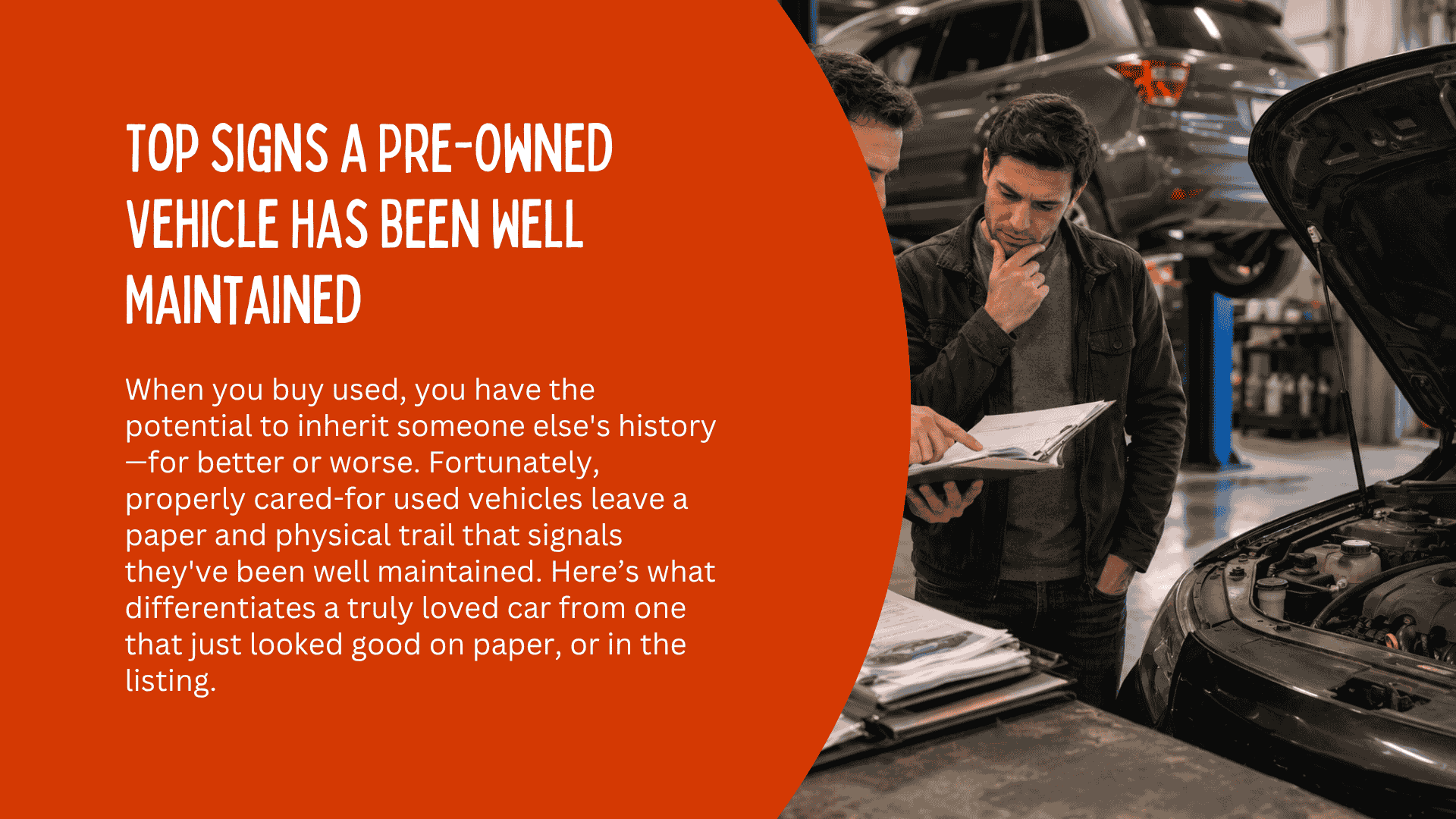
Top Signs a Pre-Owned Vehicle Has Been Well Maintained
Key Insights -The overall comprehensive maintenance record from a shop or single dealership would be preferable, showing evidence of proper car...
Read more
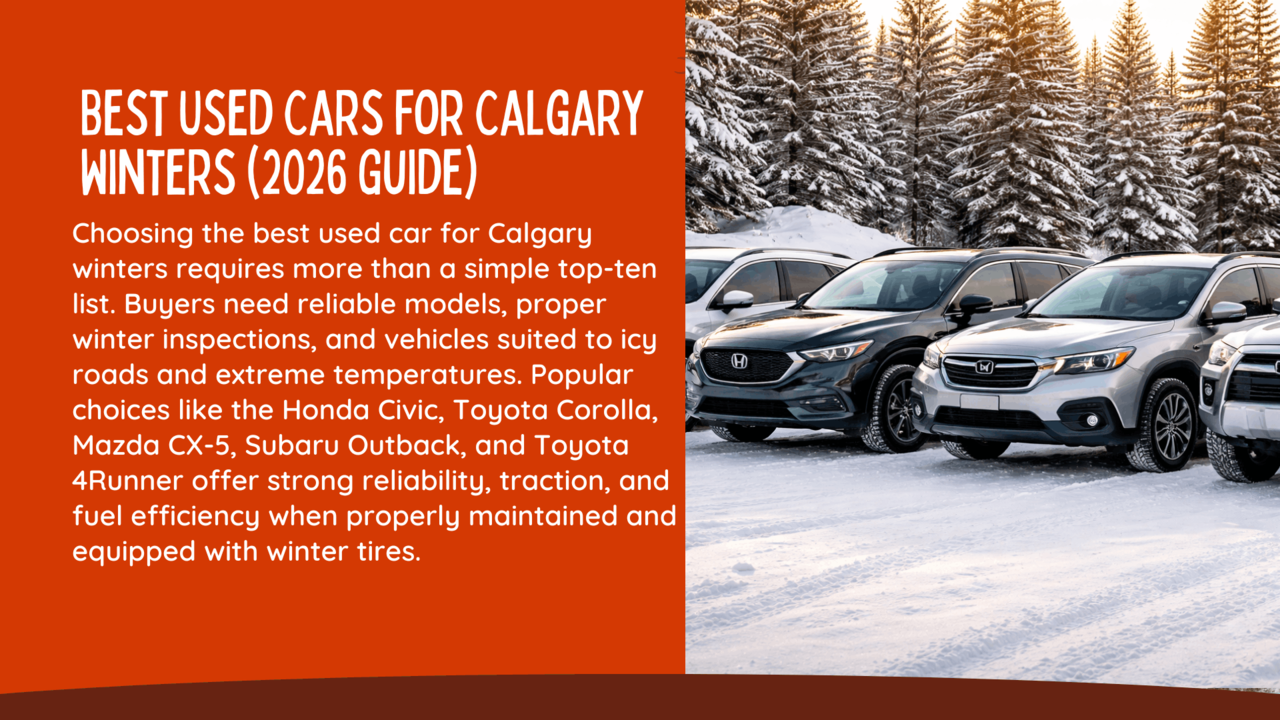
If you're searching for the best used cars for Calgary winter driving, a generic top-ten list won’t suffice. You need a system to verify that a used vehicle is genuinely winter-ready. ITo ensure you drive away with a dependable, fuel-efficient vehicle suited for Calgary’s climate, this guide provides a data-backed inspection protocol, model-specific recommendations, and a negotiation framework.
Pick the letter that fits best:
Q1. Your daily drive is mostly:
A) Deerfoot to downtown parking
B) School runs + Deerfoot + errands
C) Highway to the mountains
D) Gravel roads outside city limits
Q2. Your biggest winter headache:
A) Parking on ice + fuel costs
B) Getting stuck on my residential street
C) Highway closures ruining ski days
D) Deep snow drifts across my driveway
Q3. Your top priority:
A) Fuel economy
B) Safety + cargo space
C) Reliability—can't break down at the trailhead
D) Durability + towing capability
Mostly A's: Downtown Commuter
FWD compact + winter tires (Civic, Corolla)
Nimble parking. Best fuel economy. With winter, our brakes fail on ice.
Mostly B's: NW Family Hauler
Compact crossover AWD (CR-V, RAV4)
Ice stability + ground clearance for unplowed streets.
Mostly C's: Mountain Adventurer
Midsize SUV/truck 4WD (4Runner, Tacoma)
Holds value. Won't strand you at the trailhead in -30.
Mostly D's: Deep South Acreage
Body-on-frame truck/SUV (F-150, Tahoe)
Serious 4WD. Handles deep snow + towing.
Visit Autos House. Every Calgary Winter Certified vehicle passes battery, block heater + tire inspection.
You need specific models, not general advice. Here are the best used cars for Calgary winter based on fuel economy data, reliability scores, and real owner reports. Each recommendation includes verified inspection points so you know exactly what to check before buying.
Best for: Downtown commuters, students, budget-focused buyers
Best for: Families, NW Calgary residents, mixed-city and mountain use
Best for: Canmore commuters, acreages, ski instructors
Table
|
Vehicle |
Category |
Fuel Economy (Hwy) |
Est. Annual Fuel Cost |
Key Reliability Score |
Critical Inspection Point |
|
Honda Civic (2016-2021) |
Urban Efficiency |
6.1 L/100km |
$1,650 |
82/100 (J.D. Power) |
AC Compressor: Check TSB #16-088 (2016 models). |
|
Toyota Corolla (2017-2020) |
Urban Efficiency |
6.3 L/100km |
$1,700 |
95/100 (Cons. Reports) |
Rear Shocks: Check for oil leaks/stains. |
|
Mazda CX-5 (2017-2020) |
AWD Crossover |
8.3 L/100km |
$2,100 |
83/100 (J.D. Power) |
Brake Rotors: Check for warping/grooves (TSB #05-0018-18). |
|
Subaru Outback (2015-2019) |
AWD Crossover |
8.0 L/100km |
$2,200 |
Class-leading AWD |
Oil Consumption: Check short block records (TSB #02-157-14R). |
|
Toyota 4Runner (2010-2015) |
Mountain Hauler |
14.7 L/100km |
$3,800 |
Top-tier Longevity |
Frame Rust: Inspect rear rails for perforation/corrosion. |
Key Takeaway: The best used cars for Calgary winter share one thing—they're only as good as their maintenance history. A 4Runner with frame rust fails. A Civic with a dead AC compressor needs negotiation. Use these inspection points as leverage.
Insider Tip: Every vehicle at Autos House undergoes the Calgary Winter Certification. We verify block heaters, load-test batteries, and inspect tires before listing. Skip the guesswork. Drive away confident.
Print this. Bring it with you. Spend 10 focused minutes.
That’s the difference between a reliable winter vehicle and a $3,000 mistake.
Key Takeaway: These 10 minutes of inspection save you thousands. The best used cars for Calgary winter pass every check.
Insider Tip: These 12 points have already been met by every car at Autos House. Before listing, we check tire load test batteries and confirm block heaters. Avoid doing the work. Go with confidence.
You bought it. Now make it survive Calgary winter. Follow this timeline.
Follow AMA guidelines. Pack:
|
Category |
Item(s) |
Primary Purpose |
|
Traction |
Cat litter or traction mats |
Provides traction on ice or deep snow. |
|
Warmth |
Blanket, gloves, hand warmers |
Prevents hypothermia if the engine or heater fails. |
|
Visibility |
Headlamp (with extra batteries) |
Allows for hands-free repairs or navigation in the dark. |
|
Tools |
Booster cables, ice scraper, small shovel |
Essential for clearing the vehicle and managing battery failure. |
|
Signaling |
Reflective triangles |
Alerts other drivers to your presence on the shoulder. |
|
Essentials |
Power bank, protein bars, water (in a thermos) |
Maintains communication and energy levels during long waits. |
Hit a DIY car wash after the first melt. Spray the undercarriage with high-pressure. Remove salt brine before it eats your frame. This single step prevents long-term corrosion.
Key Takeaway: Thirty days of focused work saves thousands in repairs later. Winter-ready used cars, Calgary owners maintain them this way.
Finding the best used cars for Calgary winter comes down to three things: choosing the right model for your commute, inspecting it like a pro, and winterizing immediately. Follow this guide, and you will drive confidently through every Chinook melt and deep freeze this city throws at you.
Do I really need AWD in Calgary?
Not at all. An FWD car with winter tires is adequate and fuel-efficient on plowed roads. AWD offers a vital safety margin for commuting in the mountains or on unplowed residential streets. Winter tires are more important for stopping than drivetrains, according to Transport Canada.
What is the biggest mistake buyers make?
Assuming all-season tires are winter-ready. The Alberta Motor Association states that all-season tires lose traction below +7°C. Budget $1,000 for winter tires immediately after purchase.
How do I verify a block heater works?
Locate the cord near the grille. Use a $10 circuit tester from Canadian Tire to verify power flows. Missing cord? Budget $250-$400 for installation.
What is the most fuel-efficient AWD used SUV?
The Mazda CX-5 (2017-2020) leads non-hybrids at 8.3 L/100km highway per Natural Resources Canada. The RAV4 Hybrid is more efficient but costs more upfront.
Top Signs a Pre-Owned Vehicle Has Been Well Maintained
Key Insights -The overall comprehensive maintenance record from a shop or single dealership would be preferable, showing evidence of proper car...
Read more
The Definitive Guide to Used Car Financing in Canada
Key Insights Work with your own bank or credit union to get a loan pre-approved, as that will give you an impressive bargaining chip against your...
Read more
How Trade-In Value Affects Your Next Pre-Owned Vehicle Purchaseac
How Trade-In Value Affects Your Next Pre-Owned Vehicle Purchaseac Trading in your current car is often the fastest way to lower the cost of your...
Read morePowered and developed by
