How to Spot Flood-Damaged or Accident-Repaired Cars in Alberta — Buyer Guide for 2026
March 26 2026,
Every year, thousands of written-off vehicles get cleaned up, re-registered, and listed for sale — and Alberta buyers are especially exposed.
Here's what most used-car guides won't tell you: a private seller in Alberta owes you almost zero disclosure about a vehicle's damage history. Unlike licensed dealers, they aren't governed by AMVIC's Automotive Business Regulation. That gap is where buyers get hurt.
Used car inspection tips in Alberta for flood/accident built for the Alberta market — covering flood damage, accident repairs, documentation tools, and your legal rights in 2026.
Why Alberta Buyers Face a Unique Risk in 2026
|
Alberta buyers face an elevated risk because vehicles imported from other provinces may carry no damage disclosure at all. AMVIC's Automotive Business Regulation Section 31.1(1) requires licensed dealers to disclose collision repairs exceeding $3,000 — but private sellers are fully exempt from that rule. |
You'd think a province with strong consumer protection laws would have this covered. It doesn't — not for private sales.
The Alberta market receives a large volume of out-of-province inventory, including flood-damaged vehicles. A vehicle originally registered in a province with weaker disclosure standards can arrive here with a clean-looking title and no legal obligation to tell you about its past. In 2023, CARFAX data estimated that over 452,000 flood-damaged vehicles re-entered the North American market after major weather events. Canada accounts for a significant portion of these vehicles.
Next is the local context. The floods in Calgary in 2013 caused a significant surge in insurance write-offs, which continued to cycle through local auctions for years. In southern Alberta, spring thaw flooding still occurs every year. Vehicles damaged in these events do not disappear; many re-enter the market through auctions and resale channels.
Understanding this risk isn't about paranoia. It's about knowing that the market doesn't automatically protect you, which means you have to.
The next section shows you exactly what to look for before you spend a dollar.
Key Takeaway: Private sellers in Alberta face no AMVIC disclosure requirement, so protect against flood-damaged vehicles in Alberta.
The 5 Physical Signs of Flood Damage
|
The five most reliable physical signs of flood damage are: a musty odour in the seatbelt webbing, water lines inside headlight or taillight housings, damp carpet padding under the surface, unexplained rust on door and seat-track hardware, and dried mud residue behind engine-bay brackets. |
Most flood-damaged vehicles in Alberta smell fine at first. Sellers use ozone treatments and fabric fresheners that can fool your nose for 20 minutes. Here's where they can't fake it.
Pull the seatbelt all the way out. The webbing is rarely treated and almost always shows staining or a tide mark if the car was submerged at seat level. That single check has flagged more flood cars than any other in our shop's experience.
Before test driving, you should also know how to check a car’s history in Calgary.
- Smell test: Pull the seatbelt fully out. Check under the rear seats. Open the trunk and press the spare-tire well liner.
- Water lines: Shine a flashlight inside the headlight and taillight housings. Fogging or mineral deposits are definitive signs.
- Carpet padding: Press firmly on the floor in multiple spots. Surface drying is easy — foam padding holds moisture for months.
- Unexplained rust: Check door-hinge screws, seat-track bolts, and bare metal under the dash. These only corrode if submerged.
- Engine bay: Look behind brackets and inside the air-filter housing. Dried mud in tight spaces is the hardest thing to fake.
|
Seller Cover-Up Alert: The three most common disguise tactics are new carpet (which hides the padding), ozone treatment for smell, and fresh paint on visible rust. None of them fixes the seatbelt webbing, the foam padding, or the mud behind the engine brackets. |
Spending five minutes on these checks before a test drive can save you a $4,000–$8,000 repair bill.
Key Takeaway: Pull the seatbelt fully out on every used car you inspect — it's the one flood indicator sellers almost never treat.
How to Spot an Accident-Repaired Car (Even a Good One)
|
Signs of a previously accident-repaired car include mismatched panel gaps, paint overspray on rubber seals or glass edges, paint thickness above 200 microns on steel panels, fresh welds or crinkle repairs on the subframe, and an airbag or SRS warning light that has been recently reset. |
A well-repaired collision can look perfect at first glance. That's the point. Here's what gets missed when the repair shop cuts corners — or when someone tries to sell you the car without telling you it was hit.
Run your fingers along the seams between panels — hood to fender, door to quarter panel. Inconsistent gap width means a panel was replaced or rehung. Your fingers will find what your eyes miss.
When checking accident-damaged cars in Calgary, hold a flashlight at a 45-degree angle along door jambs, hood edges, and weather-stripping to reveal overspray. along door jambs, under the hood lip, and along sill weather-stripping to prevent paint overspray. On glass or rubber, overspray appears as a rough, speckled texture. Professionals are cautious, but they overlook certain things.
Three Checks That Require a Little More Effort
- Paint thickness gauge: a magnetic or eddy-current gauge reads steel panel thickness. Original factory paint sits at 100–150 microns. Readings above 200–250 indicate body filler or multiple repaint layers.
- Chassis inspection: from the front, look along each rocker panel. An uneven stance signals frame damage. From under the car, check subframe mounting points for fresh welds or crinkle-and-repair patterns.
- SRS/Airbag codes: connect a $20 OBD-II reader. A replaced airbag module sometimes leaves the SRS light on or generates erratic readiness codes even after being reset.
Knowing these signs protects you from the most expensive repairs a used car can hide — structural damage that affects every safety system on the vehicle.
Key Takeaway: Best used car inspection tips in Alberta and shine a light on door jambs — your hands and a flashlight are your best accident-repair detectors.
Even if the car looks clean inside and out, the electronics can tell a different story.
Electrical Red Flags in Accident-Damaged Cars Calgary to Test on the Spot
Most Calgary buyers skip AC testing when inspecting accident-damaged cars. and move on. That's a mistake. Flood and accident damage both show up in the electrical system first — and they show up as intermittent failures that sellers dismiss as quirks.
Test every single switch before you turn the key. Windows, mirrors, HVAC controls, infotainment, wipers, turn signals. Intermittent failures in switches you'd normally ignore are the earliest symptom of corrosion moving through a wiring harness.
Then check fluids in accident-damaged cars in Calgary before the test drive. Engine oil or transmission fluid that appears milky or light brown means water contamination — that's a definitive flood signal. A water-stained air-filter housing or frame can also indicate past submersion.
|
System to Check |
Red Flag Signal |
|
Engine oil/transmission fluid |
Milky or light-brown = water contamination. Walk away. |
|
Air filter frame |
Cardboard frame soggy or water-stained = past engine-bay submersion. |
|
All electrical switches |
Any intermittent failure = possible corroded wiring harness. |
|
Braking & steering feel |
Grinding or pulling during test drive = possible sand/debris intrusion. |
|
OBD-II codes |
Recently cleared codes = possible attempt to hide pending faults. Use a $20 reader. |
The OBD-II tip is one that most consumer guides leave out. Sellers and unscrupulous dealers clear codes before a showing. A scanner that shows zero codes on an older vehicle with known issues should actually make you more suspicious, not less.
These checks take under ten minutes and cost nothing beyond a $20 code reader you'll use for the rest of your car-owning life.
Key Takeaway: Bring used car inspection tips in Alberta tools — recently cleared codes are a red flag, not a clean bill of health.
Once you've done the physical and mechanical checks, the documentation layer is your next line of defence.
How to Check Accident-Damaged Cars Calgary History — Your 2026 Documentation Checklist
|
To verify a vehicle's history in Calgary, obtain a CARFAX Canada report, request an Alberta Vehicle Information Report from a Registry agent, use the IBC's free VIN Verify tool, run a CPIC check for stolen status, and ask your AMVIC-licensed dealer for the mandatory Mechanical Fitness Assessment. |
No physical inspection replaces proper documentation. Here are the five tools that matter for Alberta buyers — and what each one actually tells you.
- CARFAX Canada reports can reveal accident history, lien status, and ownership records. shows registered accident damage, lien status, number of previous owners, and province-of-registration history. A full report costs approximately $69.99 CAD in 2026. A free preliminary check is available at carfax.ca.
- Step 2: How to check car history in Calgary via VIR: available from any Alberta Registry agent for roughly $10–$20. Shows the vehicle's title status — active, salvage, non-repairable, rebuilt, or unsafe. This is the single most important document for an Alberta purchase.
- Step 3: How to check car history in Calgary for free: the Insurance Bureau of Canada's free tool checks whether a vehicle was declared non-repairable in Alberta, Ontario, or the Atlantic provinces. Available at ibc.ca.
- CPIC Check (free): run the VIN through the Canadian Police Information Centre database to confirm the vehicle hasn't been reported stolen. Any licensed dealer can run this; ask for a printed copy.
- AMVIC Mechanical Fitness Assessment (MFA): Every AMVIC-licensed dealer in Alberta must provide a completed MFA before sale. Review every flagged item. If a dealer hesitates to share it, that hesitation is the answer.
Together, these five tools take less than an hour and cost under $100 in total. They've helped our shop catch undisclosed damage that a visual inspection alone missed.
|
Not sure what you found in your inspection? Share your concerns with our technicians for a free, quick assessment. |
Key Takeaway: Always pull the Alberta Vehicle Information Report before any purchase — it's the only document that confirms the vehicle's legal title status in this province.
Knowing what documents to request is one thing. Knowing what the law requires sellers to hand over is another.
What Alberta Law Requires for Accident-Damaged Cars Calgary to Tell You — AMVIC Rules 2026
|
Under AMVIC's Automotive Business Regulation Section 31.1(1), licensed dealers must disclose in writing whether a vehicle was ever declared salvage, non-repairable, or unsafe, and whether collision repairs exceeded $3,000, including parts and labour. Private sellers face no equivalent requirement. |
Most accident-damaged cars, Calgary buyers assume disclosure requires them to tell them everything. In Alberta, that's only true when you're dealing with a licensed dealer — and even then, the thresholds matter.
Here are the accident-damaged cars, Calgary AMVIC requirements of what AMVIC requires from licensed dealers in 2026:
- Written disclosure of whether the vehicle was ever declared salvage, non-repairable, or unsafe.
- Written disclosure if collision repairs exceeded $3,000 in parts and labour.
- Written disclosure if the vehicle was previously registered in another jurisdiction.
- A completed Mechanical Fitness Assessment before the point of sale.
Private sellers are fully exempt from all of the above. This is the regulatory gap that makes private-sale used cars a higher-risk purchase category in Alberta.
A third category is also present: curbers. In order to evade AMVIC oversight, these unlicensed individuals pretend to be private sellers. They frequently operate outside of the Consumer Protection Act and sell damaged cars without disclosing anything.
It's important to take note if a private seller lists several cars annually or exhibits unusually professional behavior during the transaction.
If a licensed dealer violates these disclosure rules, you can file a complaint with AMVIC at 1-877-279-8200. The Consumer Protection Act (Alberta) classifies misrepresentation of vehicle history as an unfair trade practice.
Key Takeaway: AMVIC's $3,000 disclosure threshold only applies to licensed dealers — private sellers can legally say nothing about a vehicle's damage history.
Now that you know what you're entitled to, the real question is: what do you do with what you find?
When to Walk Away from Accident-Damaged Cars Calgary — and When to Negotiate
Not every accident-damaged car Calgary red flag means walk away means a bad car. Some do. Knowing the difference is what separates a confident buyer from one who either overpays for a problem vehicle or walks away from a fair deal unnecessarily.
Here's a clear framework.
|
Walk Away — Non-Negotiable |
Potentially Negotiable |
|
Undisclosed salvage title |
Full disclosure with rebuilt inspection on file |
|
Visible structural/chassis damage or frame welds |
Minor cosmetic repair with written documentation |
|
Milky engine oil or transmission fluid |
Single-panel repaint with disclosure — negotiate on price |
|
Airbag light that cannot be cleared or no airbags reinstalled |
Past flood with proof of full professional remediation |
|
Seller refuses pre-purchase inspection |
CARFAX and VIR both show a clean history — verify independently |
The negotiation principle is simple. Any repair cost that an independent inspection identifies becomes a deduction from the asking price. You don't absorb risk — you price it, or you decline.
If a seller refuses to let you take the car to an independent shop before purchase, that refusal is itself the answer. Every legitimate seller understands why a buyer needs this step.
Key Takeaway: Use your inspection findings as a price-reduction lever — not as a reason to panic. Price the risk in, or walk away clean.
The most effective safety net, though, is one you arrange before you make any decision.
Why a Pre-Purchase Inspection in Calgary Is Always Worth It
|
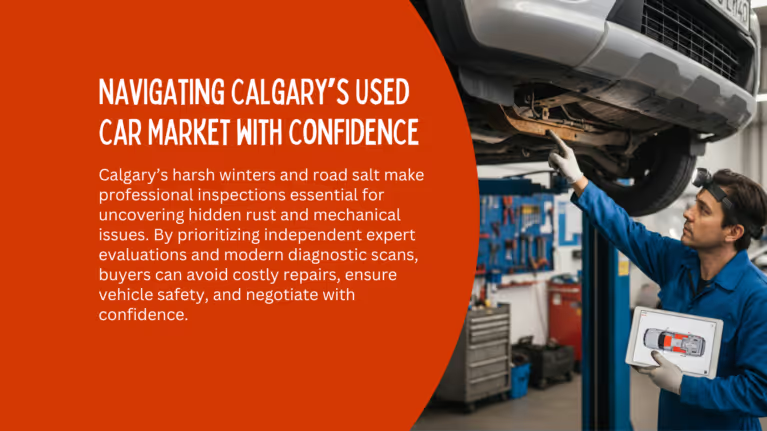
A professional pre-purchase inspection in Calgary typically costs $100–$200 in 2026 and takes one to two hours. It includes a lift inspection, paint thickness gauge reading, OBD-II scan, fluid analysis, and structural assessment — checks that no vehicle history report can replicate. |
Accident-damaged cars, Calgary math: $200 inspection vs $10K repairs. A pre-purchase inspection costs at most $200. Hidden structural damage on a mid-range used vehicle can run $4,000–$10,000 to repair correctly. AMVIC itself recommends that all used-car buyers in Alberta hire an independent licensed technician before purchase — regardless of what the dealer's MFA shows.
Here's what most guides won't say directly: a dealer's Mechanical Fitness Assessment is not a neutral document. It's completed by or arranged by the seller. An independent inspection at a shop you choose — one with no stake in the sale — is the only inspection that truly works in your interest.
At Auto House, our technicians use a paint thickness gauge on every panel, run a full OBD-II diagnostic, inspect the subframe from the lift, and check every fluid for contamination. We've identified undisclosed flood damage, hidden structural repairs, and accident histories that CARFAX Canada reports missed entirely — because not every collision gets reported to an insurer.
Key Takeaway: A $150 pre-purchase inspection is the cheapest insurance you can buy on a used car — and it's the only check with no conflict of interest.
The Bottom Line: Accident-Damaged Cars Calgary Protection Used-Car Buyers in 2026
Alberta's used-vehicle market carries risks that most national used-car guides simply don't address. The combination of out-of-province inventory, a private-seller disclosure exemption, and a history of regional flood events creates conditions where damaged vehicles can circulate without obvious flags.
With a five-tool documentation checklist, a clear map of your legal rights under AMVIC, physical inspections for flood damage and accident repairs, and a framework for deciding whether to negotiate or walk away, you now have the whole toolkit.
The last step — and the one that protects you against everything a visual inspection can miss — is a professional pre-purchase inspection at an AMVIC-licensed Calgary shop. Book yours at Auto House before you commit to any used-vehicle purchase. Same-week appointments are available.
|
Book a Pre-Purchase Inspection at Auto House — Calgary Trusted, AMVIC-Licensed. Same-Week Appointments Available. [Book Now] |
Frequently Asked Questions
What is a rebuilt title in Alberta?
A rebuilt title means the vehicle was previously declared salvage but has been repaired and passed an inspection by a licensed Alberta technician. The rebuilt designation stays on the title permanently. It can be registered and insured, but its resale value is lower than that of a clean-title vehicle. Rebuilt inspections in Alberta typically cost $200–$400 through an AMVIC-licensed shop.
Can dealers in Alberta hide accident history from buyers?
Not legally. AMVIC's Automotive Business Regulation requires licensed dealers to disclose collision repairs exceeding $3,000 and any previous salvage or non-repairable designation. However, private sellers face no equivalent requirement. For complaints about dealer non-disclosure, contact AMVIC at 1-877-279-8200.
How do I check if a used car has flood damage?
Pull the seatbelt fully out and check for staining. Inspect carpet padding by pressing firmly — damp resistance means moisture. Check headlight and taillight housings for fogging. Look under the dash and on door-hinge hardware for unexplained rust. Confirm through CARFAX Canada and the free IBC VIN Verify tool at ibc.ca.
Is it safe to buy accident-damaged cars in Calgary with repairs?
It depends entirely on the severity and quality of the repair. Minor cosmetic damage with full documentation and an I-CAR-certified repair is generally acceptable. Structural frame damage, unreplaced airbags, or repairs made without OEM specifications are safety disqualifiers. An independent pre-purchase inspection is the only way to know which category you're in.
How much does a pre-purchase inspection cost in Calgary in 2026?
Expect to pay $100–$200 at most reputable Calgary shops. The inspection should include a lift review, paint thickness readings, OBD-II diagnostics, fluid analysis, and a structural assessment. At Auto House, same-week appointments are available with no hidden fees.
What is IBC VIN Verify, and is it free?
IBC VIN Verify is a free tool from the Insurance Bureau of Canada that checks whether a vehicle was declared non-repairable in Alberta, Ontario, or the Atlantic provinces. Find it at ibc.ca. It supplements but does not replace a CARFAX Canada report — both checks together give you the most complete picture.