Top Signs a Pre-Owned Vehicle Has Been Well Maintained
Key Insights -The overall comprehensive maintenance record from a shop or single dealership would be preferable, showing evidence of proper car...
Read more
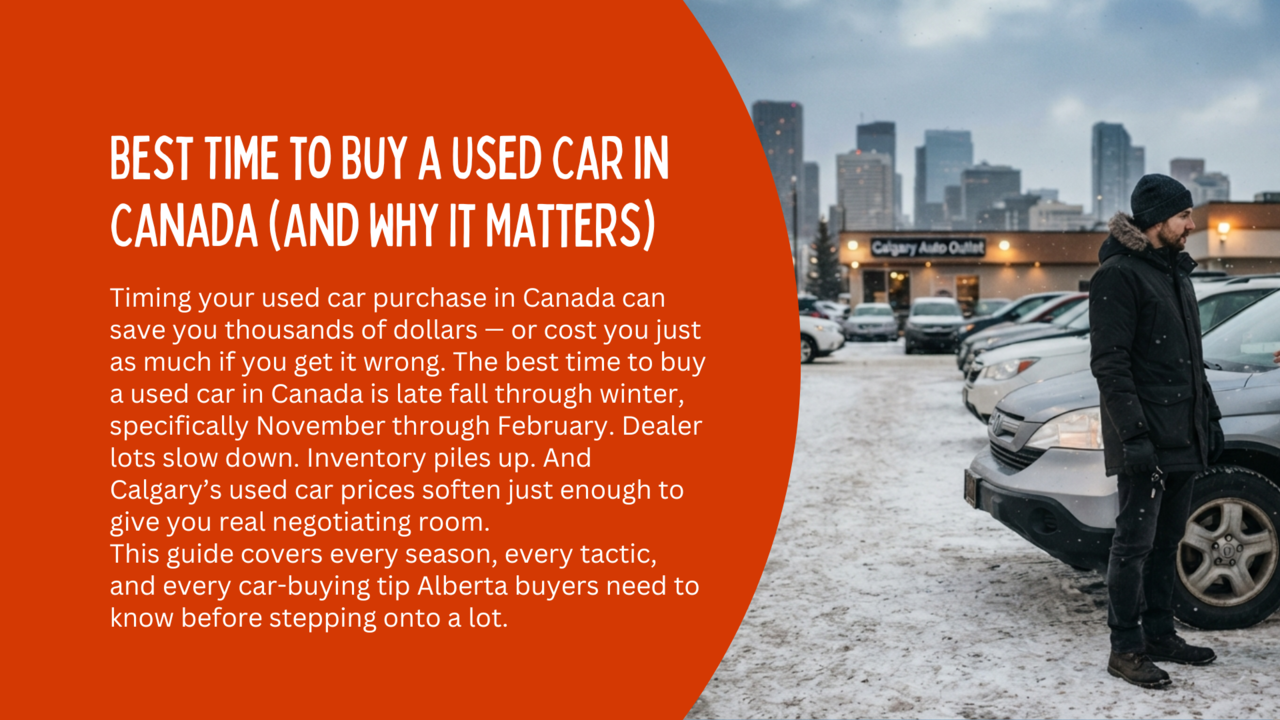
Timing your used car purchase in Canada can save you thousands of dollars — or cost you just as much if you get it wrong. The best time to buy a used car in Canada is late fall through winter, specifically November through February. Dealer lots slow down. Inventory piles up. And Calgary’s used car prices soften just enough to give you real negotiating room.
This guide covers every season, every tactic, and every car-buying tip Alberta buyers need to know before stepping onto a lot.
November and December are among the best months to buy a used car in Canada. Dealers are under pressure to clear inventory before the new year.
The national average used vehicle price sat at $36,713 at the end of March 2026 — the lowest March level since 2022 (AutoTrader.ca, Automotive Price Index, 2026).
Why? Dealers want to meet annual sales quotas and free up space for newer models.
Pro Tip: Visit dealerships in the last few days of December for maximum discounts.
Calgary car dealerships run on monthly and quarterly sales targets. If they’re falling short, they’re more willing to negotiate a lower price on a used car in Canada.
This strategy works year-round, but it's most effective in January and February, when post-holiday buyer traffic is already thin (WealthNorth, Best Time to Buy a Car in Canada, updated April 2026).
Why? Sales staff reset their targets every month. A deal that costs them nothing in Week 1 is worth more to them in Week 4.
Pro Tip: In the final week of any month, go shopping on a Tuesday or Wednesday. Dealers will focus more on you if there is less foot traffic.
Honestly, this is the best time to buy a used car in Canada if price is your main goal. Demand drops hard after the holidays. Lots fill up. Dealers deal.
Used car prices nationally held steady at $34,139 in March 2026, up just 0.5% — the 7th consecutive month of plateau (Clutch Technologies Inc., Used Car Pricing Report, March 2026).
Calgary's winter keeps casual shoppers off dealer lots, reducing competition and creating better opportunities for buyers to negotiate discounts.
Why? Fewer buyers = more leverage. Dealers carry floor-plan financing costs every month a car sits unsold.
Pro Tip: A car on the lot since October becomes a liability by January. That’s your leverage.
Browsing used cars in Calgary right now? Check Autos House's current inventory within your budget. — no pressure, just options.
Fall brings a different kind of opportunity. As new model-year vehicles arrive, trade-ins flood the used market — creating the widest selection of the year.
Between August and October, drivers trading in 2–3-year-old models feed Calgary used inventory directly. Outgoing-generation models also see softer pricing (Tabangi Motors, Best Time to Buy a Used Car in Canada, January 2026).
Why? New arrivals need floor space. Dealers discount older inventory fast.
Pro Tip: If you want a specific trim, color, or model — this is your best window for selection before winter thins it out.
Here’s how each season stacks up for seasonal car sales Canada buyers:
|
Season |
Best For |
Watch Out For |
|
Winter (Jan–Feb) |
Lowest prices, most dealer flexibility |
Thinner selection, fewer listings |
|
Spring (Mar–May) |
Fresh trade-ins, rising inventory |
Prices start climbing with demand |
|
Summer (Jun–Aug) |
Lot sales on slow-moving stock |
Peak demand, less room to negotiate |
|
Fall (Sep–Nov) |
Widest selection, new trade-in influx |
Prices not yet at winter lows |
The Bank of Canada’s overnight rate is holding at 2.25%, unchanged since October 2025 (Bank of Canada, via WOWA.ca, June 2026). That stability means lenders aren’t likely to jack up auto loan rates mid-search.
However, the cost of used car loans is still high. By February 2026, the average had increased from 4.45% in 2017 to 6.72 percent (Statistics Canada data, via Finder Canada, 2026). Typically, non-CPO loans begin at 7.99 % (Finder Canada, 2026).
Why? A car $1,000 cheaper at a higher rate can cost more over 3 years than a pricier car at a lower rate.
Pro Tip: Get pre-approved through your bank before you shop. Then compare the dealer’s offer in writing.
Need flexible financing on a used car in Calgary? Autos House Calgary offers multiple financing options — including for buyers with less-than-perfect credit.
Alberta has no “cooling-off” period for vehicle purchases. Once you sign the bill of sale, the deal is final — even if you find a better price the next day (AMVIC, Financial February consumer bulletin, February 2026).
AMVIC reissued this warning in 2026 because too many buyers assume they have a few days to back out. They don’t.
Why? Dealers can legally enforce the contract the moment you sign. There is no grace period.
Pro Tip: Before you sign anything, make sure your dealer has an AMVIC license at amvic.org.
Before signing, always:
Alberta is the only province without a provincial sales tax (PST), meaning only the 5% GST applies to dealership vehicle purchases. There is only a 5% federal GST on dealership purchases. Individual private sales are tax-free (Alberta GST Only Car Tax Guide, 2026).
On a $30,000 used car: you pay $1,500 GST in Alberta vs. $3,900 HST in Ontario. That difference is real money.
Why? Alberta’s no-PST structure is a built-in price advantage Calgary buyers have over every other province.
Pro Tip: Budget between $150 and $250 for an out-of-province vehicle inspection prior to registration if you are bringing a car from another province (Alberta Vehicle Bill of Sale guidance, 2026).
Calgary roads — road salt, gravel highways, hail — create wear patterns that don’t always show on a walkaround. Frame damage from prior collisions is the most commonly missed issue by buyers who skip an independent inspection (Shift Happens Auto Sales, Used Car Inspection Checklist Alberta, 2026).
A pre-purchase inspection runs $150 to $300 and can catch structural damage, deferred maintenance, and battery issues — all common in Calgary’s climate (Shift Happens Auto Sales, 2026).
In a private sale, sellers aren’t required to disclose this damage. Buying from an AMVIC-licensed dealer gives you legal protections and a formal complaint process if something goes wrong post-purchase (Shift Happens Auto Sales, 2026).
Why? A $200 inspection can reveal a $3,000 problem you’d otherwise inherit.
Pro Tip: Winter inspections are actually useful — battery health, seal cracking, and undercarriage rust show up more clearly in cold weather.
The best time to buy a used car in Canada is November through February — when prices are softest, and dealers are most motivated.
Layer that with Alberta’s zero-PST tax advantage, the Bank of Canada’s stable 2.25% rate, and smart negotiation tactics, and you have a real edge.
Always check AMVIC licensing, run a vehicle history report, and get a pre-purchase inspection before signing anything.
If you’ve been waiting for the right moment — winter is it. Autos House Calgary has the inventory. You bring the checklist.
Ready to find your next used car in Calgary? Book a free no-pressure walkthrough at Autos House Calgary today — tell us your budget and timeline, and we’ll show you exactly what’s available.
Q: Is January really the cheapest month to buy a used car in Canada?
A: Yes — January and February consistently show the softest used car prices in Canada. Shopper demand drops after the holidays and dealer pressure to move inventory increases (WealthNorth, 2026).
Q: Do used car prices in Calgary follow the national average?
A: Mostly, with Alberta-specific twists. Used EV prices fell 19.4% year-over-year in Alberta — the steepest provincial drop — while truck prices held near $50,000, well above the national average of $34,139 (Clutch Technologies Inc., March 2026).
Q: Does Alberta charge sales tax on used cars?
A: There is no provincial sales tax. GST on dealership purchases is only five%. Alberta has the lowest tax rates in Canada for car purchases because private sales are totally tax-free.
Q: Is there a cooling-off period for used car purchases in Alberta?
A: No. Once you sign the bill of sale, the contract is legally enforceable — even if you find a better deal the next day. AMVIC confirmed this again in February 2026.
Top Signs a Pre-Owned Vehicle Has Been Well Maintained
Key Insights -The overall comprehensive maintenance record from a shop or single dealership would be preferable, showing evidence of proper car...
Read more
The Definitive Guide to Used Car Financing in Canada
Key Insights Work with your own bank or credit union to get a loan pre-approved, as that will give you an impressive bargaining chip against your...
Read more
How Trade-In Value Affects Your Next Pre-Owned Vehicle Purchaseac
How Trade-In Value Affects Your Next Pre-Owned Vehicle Purchaseac Trading in your current car is often the fastest way to lower the cost of your...
Read morePowered and developed by
