Top Signs a Pre-Owned Vehicle Has Been Well Maintained
Key Insights -The overall comprehensive maintenance record from a shop or single dealership would be preferable, showing evidence of proper car...
Read more
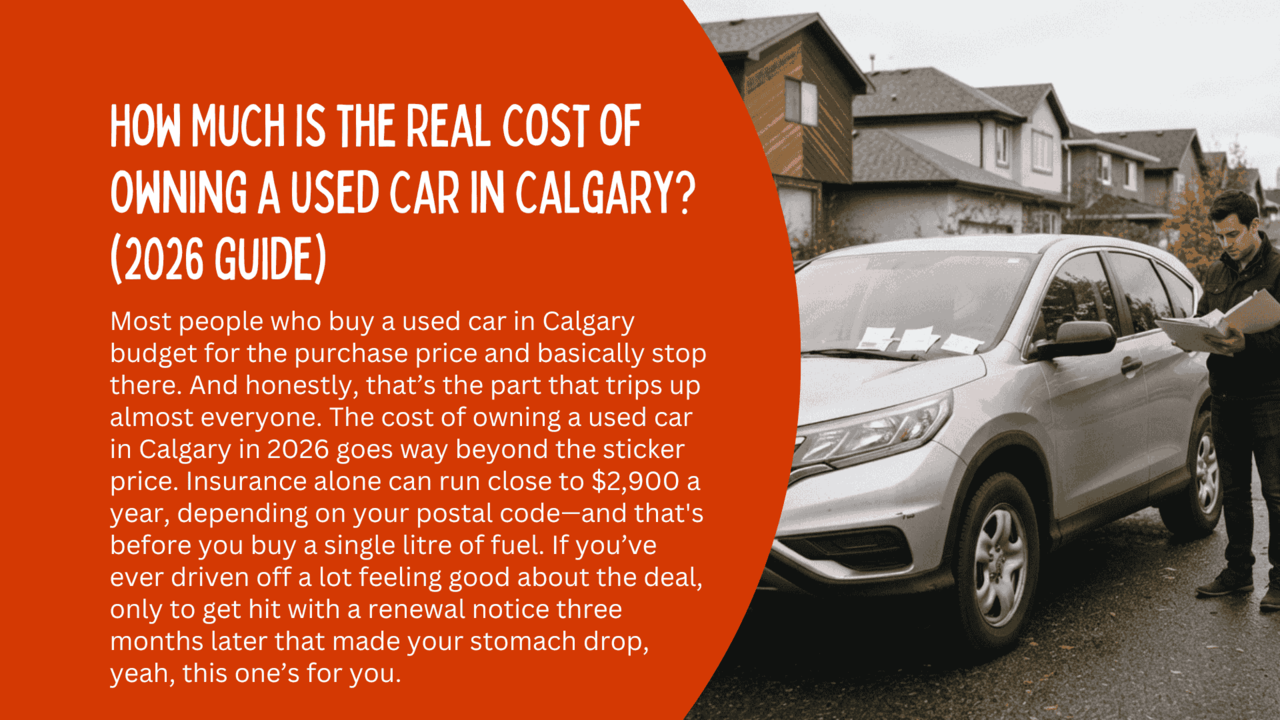
Most people who buy a used car in Calgary budget for the purchase price and basically stop there. And honestly, that’s the part that trips up almost everyone. The cost of owning a used car in Calgary in 2026 goes way beyond the sticker price. Insurance alone can run close to $2,900 a year, depending on your postal code—and that's before you buy a single litre of fuel. If you’ve ever driven off a lot feeling good about the deal, only to get hit with a renewal notice three months later that made your stomach drop, yeah, this one’s for you. By the end of this, you’ll know exactly what to budget for, month by month, so nothing catches you off guard.
The average cost of owning a used car in Calgary in 2026 sits between roughly $9,500 and $14,000 a year, once you factor in insurance, fuel, maintenance, and registration fees, and where you land in that range depends heavily on your vehicle size and where in the city you live.
That’s a big range. It's not random, though. According to the Canadian Automobile Association's 2024 Driving Costs report, the annual operating costs of a mid-size SUV are estimated to be approximately $14,400 while those of a compact car are approximately $9500. In Calgary in particular, insurance is typically the biggest swing factor because, as I was also surprised to learn, your precise postal code can affect your premium by nearly $800 annually.
Here’s a rough month-by-month split for a typical compact used car:
Knowing this upfront lets you compare used cars based on their total monthly ownership cost—not just the purchase price. However, since insurance is rarely what people expect in Calgary, it merits its own breakdown.
Calgary is one of the most expensive cities in Alberta for auto insurance, with an average annual cost of $2867 or roughly $239 per month (ThinkInsure 2026).
According to ThinkInsure's 2026 quote data, Calgary premiums range from roughly $2660 in the T2P postal code area to $3430 in T3N. This represents an annual difference of about $800 for essentially the same driver profile (ThinkInsure 2026). I suppose that's what no one tells you when you're looking for a used car: your address is just as important as your driving history.
Car insurance in Alberta is notoriously expensive, with drivers shelling out an average of $1,800 in 2025, according to the provincial rate board.
To help lower those premiums, Alberta is shifting to a "no-fault" insurance model. Instead of insurance companies spending months fighting over who caused an accident, your own insurer will handle your medical and vehicle claims immediately, regardless of who was at fault. The province is betting that cutting out these costly legal battles will finally drive down those high annual bills.
Calgary still runs above that provincial number, and separate market data from Western Financial Group puts the typical Calgary driver at $2,200 to $2,300 a year (Western Financial Group, 2026).
A few things that move your premium:
One thing worth doing before you even buy: get an insurance quote for the exact make, model, and year you’re considering — not just “a used Honda Civic.” Two trims of the same car can come back with very different numbers. That alone can save you a few hundred dollars a year, and it takes maybe ten minutes.
So insurance is the big one. But fuel is the cost that actually changes week to week — and 2026 has been a wild ride for gas prices.
Calgary drivers were paying around $1.63 a litre for regular gas as of early June 2026, slightly below the national average of $1.76, making Alberta one of the cheaper provinces to fuel up in (Finder.com, citing Statistics Canada CPI data, June 2026).
That’s the good news, relatively speaking. But — and this is the part a lot of cost calculators skip — about 17.6 cents of every liter in 2026 is the federal carbon tax, calculated at $80 per tonne of CO2 (WestNet, May 2026). So even Alberta’s “cheap” gas has a built-in cost that’s only going one direction.
Here’s what that looks like for a compact car doing average city driving:
|
Monthly Distance |
Liters Used (approx.) |
Monthly Fuel Cost at $1.63/L |
|
1,000 km |
~80 L |
~$130 |
|
1,500 km |
~120 L |
~$196 |
|
2,000 km |
~160 L |
~$261 |
If your used car is reliable, you're already in a better position, especially when fuel prices fluctuate, especially since Calgary's premium gas has recently been hovering around $1.86 per liter. GlobalPetrolPrices.com tracks prices from March to June 2026 with a brief spike to $2.07 in early May. Therefore, having a dependable car is not only practical, but it also relieves you of the burden of unforeseen repair bills at a time when fuel prices are already straining your finances.
Using the CRA’s 73-cent mileage rate as a "sanity check" is a smart move if you're self-employed. Because the government calculates that baseline from real-world data, it is a highly reliable benchmark for tracking the total cost of car ownership for your business.
When you break down the actual cost of owning a used car, Calgary business owners face, that 73-cent threshold fills up incredibly fast:
It is a great reminder that your real used car expenses Canada-wide data are shaped by local realities—making that federal rate a perfect tool to ensure your business vehicle isn't quietly bleeding you dry.
Fuel costs fluctuate weekly. Maintenance costs, on the other hand, are where used cars start to separate from new ones — and where Calgary’s climate plays a bigger role than most people realize.
The Canadian Automobile Association notes that owning a vehicle represents a significant annual expense. Calculating the true cost of owning a used car in Calgary means factoring in severe climate wear that standard used car expenses Canada estimates are missing. The average monthly cost of maintaining a used car with more than 80,000 kilometers is between $80 and $150. However, local freeze-thaw cycles and aggressive winter road salt quickly increase the need for costly suspension and brake overhauls.
When you layer these unpredictable repairs on top of a notoriously high car insurance Calgary cost and highly volatile fuel cost Canada 2026 pump prices, navigating the true vehicle maintenance cost Alberta demands requires a much larger monthly buffer than a basic oil change.
A few maintenance items that come up more often in Calgary than elsewhere:
Here’s the thing — a used car that’s been well-maintained by its previous owner can save you hundreds in that first year. Ask for service records. If the seller can’t produce any, budget extra for the unknowns. That isn't being overly cautious—it's smart budgeting.
Maintenance is unpredictable. Registration and one-time fees, though, are fixed — and they’re smaller than people assume, but they still add up.
Registering a used vehicle in Alberta includes a mandatory $12 Motor Vehicle Accident Claims Fund fee built into the registration cost, plus smaller fees that buyers often forget to budget for.
This one’s small, but it surprises people. Every passenger vehicle registration in Alberta carries that $12 fund fee as part of the official Registry Agent Product Catalog (Alberta.AllVehiclesData.com, 2026). On top of that, if you’re buying through a licensed dealer, AMVIC requires the dealer to remit a $10 levy on every vehicle sold — and there’s also a $5 tire recycling fee per tire under Alberta’s Tire Recycling Bylaw (AMVIC, 2025).
So for a standard four-tire passenger car, that’s:
None of these is a deal-breaker. But they’re the kind of small-dollar items that, added together, can mean an extra $40–$50 at the registry counter that nobody mentioned when you agreed on the price. Ask your dealer for an all-in number before you sign anything — it’s a fair question and any reputable seller in Calgary will answer it straight.
And if you’re considering an electric used vehicle, there’s one more line item that’s easy to miss entirely.
Used electric vehicle owners in Alberta pay an additional $200 annual registration tax on top of standard fees, a cost that doesn’t apply to gas, diesel, or hybrid vehicles.
This tax took effect in 2025 specifically because EV drivers don’t pay fuel tax, and the province says EVs cause more wear on roads due to their weight (Government of Alberta budget, via CBC, 2025). Hybrids are exempt — only fully electric vehicles pay it.
For someone shopping used EVs in Calgary, that’s a real number to add to your annual total — roughly $17 a month that a comparable used gas car simply doesn’t carry. It doesn’t make EVs a bad choice; lower fuel and maintenance costs often offset it. But it’s exactly the kind of detail that gets left out of generic “cost of ownership” articles, and it can shift your monthly budget by a noticeable amount either way.
Now that you’ve got the individual pieces, let’s put them together into one number you can actually plan around.
For a typical used compact car in Calgary in 2026, the total cost of car ownership lands around $800 to $1,000 a month once insurance, fuel, maintenance, and fees are combined, with insurance and fuel making up roughly 70% of that total.
Statistics Canada’s most recent Survey of Household Spending found the average Canadian household spent $13,294 annually on private transportation, covering fuel, insurance, depreciation, financing, parking, and maintenance combined (Statistics Canada, Survey of Household Spending, Table 11-10-0222). That’s a national average across all vehicle types and household sizes — Calgary’s higher insurance costs likely push local numbers toward the upper end of that range for a single-vehicle household.
Here’s a simple annual estimate for a used compact car in Calgary:
|
Category |
Annual Estimate |
|
Insurance |
$2,200 – $2,900 |
|
Fuel (1,500 km/month avg.) |
$1,800 – $2,400 |
|
Maintenance & repairs |
$1,000 – $1,800 |
|
Registration & fees |
$130 – $180 |
|
Total |
$5,130 – $7,280 |
That’s lower than CAA’s $9,500 figure because CAA’s number includes depreciation and financing costs that vary enormously depending on how much you paid for your used car and whether you financed it. If you bought outright with cash, your real annual cost is closer to the table above. If you’re financing, add your loan payments on top.
When you compare these numbers to typical used car expenses Canada-wide, Calgary actually comes out roughly average — slightly cheaper on fuel, slightly pricier on insurance. It mostly balances out.
This is the part where it pays to actually run your own numbers before you commit — not after.
Knowing the real cost of owning a used car in Calgary changes how you shop. A car that’s $2,000 cheaper upfront but costs $300 more a year to insure isn’t actually the better deal, and now you’ve got the numbers to prove it either way. Between Calgary’s wide insurance variance by postal code (ThinkInsure, 2026) and the province’s relatively affordable fuel prices (Finder.com, 2026), your two highest controllable costs are insurance shopping and choosing a vehicle with lower maintenance costs in our winters.
Get insurance quotes for each specific model of used car you're considering before making a decision; that one step alone can change your monthly budget by at least $50.
Q: How much does it cost to insure a used car in Calgary?
A: Coverage in cities is steep. The annual cost of auto insurance in Calgary is approximately $2,867 ($239/month), with neighborhood-specific rates ranging from $2,660 to $3,430. This is significantly more than the $1,800 Alberta provincial baseline.
Q: Is gas more expensive in Calgary than the rest of Canada?
A: No, local drivers get a break. While tracking lower than the general fuel cost Canada 2026 averages, Alberta pumps sit around $1.63 a liter compared to the $1.76 national average, which includes a built-in 17.6-cent federal carbon tax.
Q: How much should someone budget monthly for a used car in Calgary?
A: The monthly cost of owning a used compact car typically ranges between $430 and $610. You will need to add your monthly loan payments if you financed the vehicle, but fuel, insurance, and routine maintenance are all covered.
Q: Do electric vehicles cost more to register in Alberta?
A: Yes. Yes. Owners of fully electric vehicles must pay an additional $200 annual registration tax in Alberta. Hybrid vehicles are exempt from a flat $200 annual provincial infrastructure tax to their registration fees, though hybrid models remain exempt.
Q: What hidden fees should I expect when buying a used car in Alberta?
A: Expect a few administrative extras to impact your initial used car expenses Canada calculations: a $12 accident fund registry fee, and—if buying from a dealer—a $10 AMVIC levy plus a $5 per-tire recycling fee. These add $40 to $50 to your upfront vehicle maintenance cost in Alberta buffer.
Top Signs a Pre-Owned Vehicle Has Been Well Maintained
Key Insights -The overall comprehensive maintenance record from a shop or single dealership would be preferable, showing evidence of proper car...
Read more
The Definitive Guide to Used Car Financing in Canada
Key Insights Work with your own bank or credit union to get a loan pre-approved, as that will give you an impressive bargaining chip against your...
Read more
How Trade-In Value Affects Your Next Pre-Owned Vehicle Purchaseac
How Trade-In Value Affects Your Next Pre-Owned Vehicle Purchaseac Trading in your current car is often the fastest way to lower the cost of your...
Read morePowered and developed by
