Top Signs a Pre-Owned Vehicle Has Been Well Maintained
Key Insights -The overall comprehensive maintenance record from a shop or single dealership would be preferable, showing evidence of proper car...
Read more
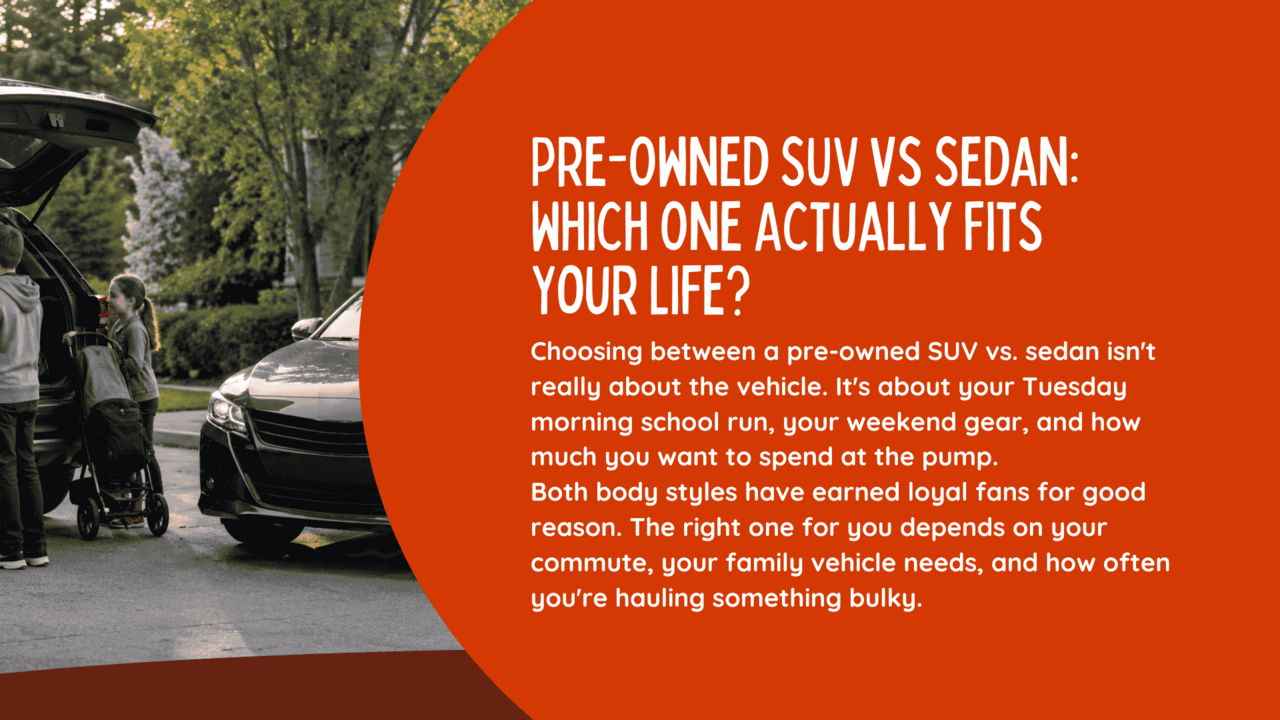
Choosing between a pre-owned SUV vs. sedan isn't really about the vehicle. It's about your Tuesday morning school run, your weekend gear, and how much you want to spend at the pump.
Both body styles have earned loyal fans for good reason. The right one for you depends on your commute, your family vehicle needs, and how often you're hauling something bulky.
Here's how each one actually stacks up.
Need cargo space, higher seating, and snow confidence? Go with a used crossover or SUV. Want better fuel economy, easier parking, and a lower price tag? A sedan still holds its own. Different vehicles for different priorities; there's no universal winner.
A used crossover or SUV typically offers considerably more cargo space than a comparable sedan, further enhanced by fold-flat seats and a wider cargo opening.
Compare it to a duffel bag and a backpack. They both carry items. Simply put, odd-shaped loads are easier to handle.
That extra volume matters if you're regularly hauling:
Sedans aren't out of the running here, either.
Best for cargo needs: an SUV or crossover, hands down, if you move bulky items often.
Sedans traditionally beat SUVs on fuel economy, thanks to a lighter body and lower ride height that cut down on drag.
If you're commuting long distances — say, along Ontario's 400-series highways or between Calgary and Edmonton — that mileage difference adds up fast over a year.
Natural Resources Canada publishes official fuel consumption ratings for new and used model years. It's a solid starting point before comparing specific trims.
That said, the gap has narrowed:
Don't assume every SUV is a gas guzzler. Check the model-specific rating before you rule one out.
If your household is growing, an SUV or crossover generally gives you more flexibility as a family vehicle — starting with how much easier they make loading kids and gear.
A few reasons families lean toward SUVs:
Sedans still make sense for smaller families or couples without kids yet.
A well-equipped used sedan can offer strong safety ratings, a smooth ride, and lower running costs — while still fitting two car seats comfortably if that's as far as the family has grown.
Sedans sit lower to the ground, which gives them a more planted, car-like feel through corners and highway on-ramps.
If you enjoy a more responsive driving experience, a sedan may feel more engaging. It's the difference between low-profile trainers and hiking boots — one hugs the road, the other's built for rougher ground.
SUVs and crossovers trade some of that agility for:
Transport Canada publishes seasonal driving guidance worth a look before deciding how much winter capability you actually need. Sedans with proper winter tires still perform well for drivers who don't need extra ground clearance.
Due in large part to crossover demand driving up used SUV prices across the Canadian market, sedans are typically less expensive to buy than SUVs of comparable age and mileage.
For a tighter budget, a pre-owned sedan often stretches further — sometimes landing you a higher trim or newer model year for the same money as a base used crossover.
SUVs and crossovers may offer stronger resale value over time. Strong ongoing demand means a well-maintained used SUV usually holds more of its value at resale or trade-in.
Ready to compare listings side by side? A quick browse through current inventory will show you how much that price gap actually looks like on real vehicles near you.
Choose a pre-owned sedan if you:
Choose a pre-owned SUV or crossover if you:
A few used-vehicle basics apply no matter which body style you land on.
Is it more expensive to insure an SUV than a sedan?
Your driving history, trim level, and model all matter. Certain small crossovers are insured similarly to sedans, but larger SUVs with higher replacement costs might have higher premiums. Get quotes for the particular vehicle you are considering.
Do SUVs cost more to maintain than sedans?
Due to their size and weight, SUVs can typically run slightly higher on tires, brakes, and fluids; however, this varies by make and model. More important than just the body style is a pre-purchase inspection and complete maintenance history.
Are hybrid SUVs a good alternative to a sedan for fuel economy?
Yes, for many buyers. Hybrid and electrified crossovers have narrowed the fuel economy gap that used to favor sedans, while keeping the cargo space and higher seat of an SUV.
Should I finance a used SUV differently than a used sedan?
The financing process is the same either way. Loan amounts may differ since SUVs often carry higher price tags. Compare total loan cost — principal plus interest — not just the monthly payment.
When it comes to the pre-owned SUV vs. sedan debate, there isn't a single correct answer—just the one that works best for you at the moment. A used crossover or SUV will probably be more beneficial to you in the long run if weekends involve car seats, camping trips, or winter roads that require extra clearance. A used sedan is still the sensible option if you commute alone or are a couple trying to save money without compromising comfort.
Take stock of your cargo needs, commute length, and budget before you start browsing listings. It makes the rest of the buying process a lot less overwhelming.
Top Signs a Pre-Owned Vehicle Has Been Well Maintained
Key Insights -The overall comprehensive maintenance record from a shop or single dealership would be preferable, showing evidence of proper car...
Read more
The Definitive Guide to Used Car Financing in Canada
Key Insights Work with your own bank or credit union to get a loan pre-approved, as that will give you an impressive bargaining chip against your...
Read more
How Trade-In Value Affects Your Next Pre-Owned Vehicle Purchaseac
How Trade-In Value Affects Your Next Pre-Owned Vehicle Purchaseac Trading in your current car is often the fastest way to lower the cost of your...
Read morePowered and developed by
