
The Canadian Guide to Buying Used Cars with Apple CarPlay and Android Auto
Buying a used vehicle today involves more than a test drive and a quick inspection of the engine bay and undercarriage, not to mention checking the...
Read more
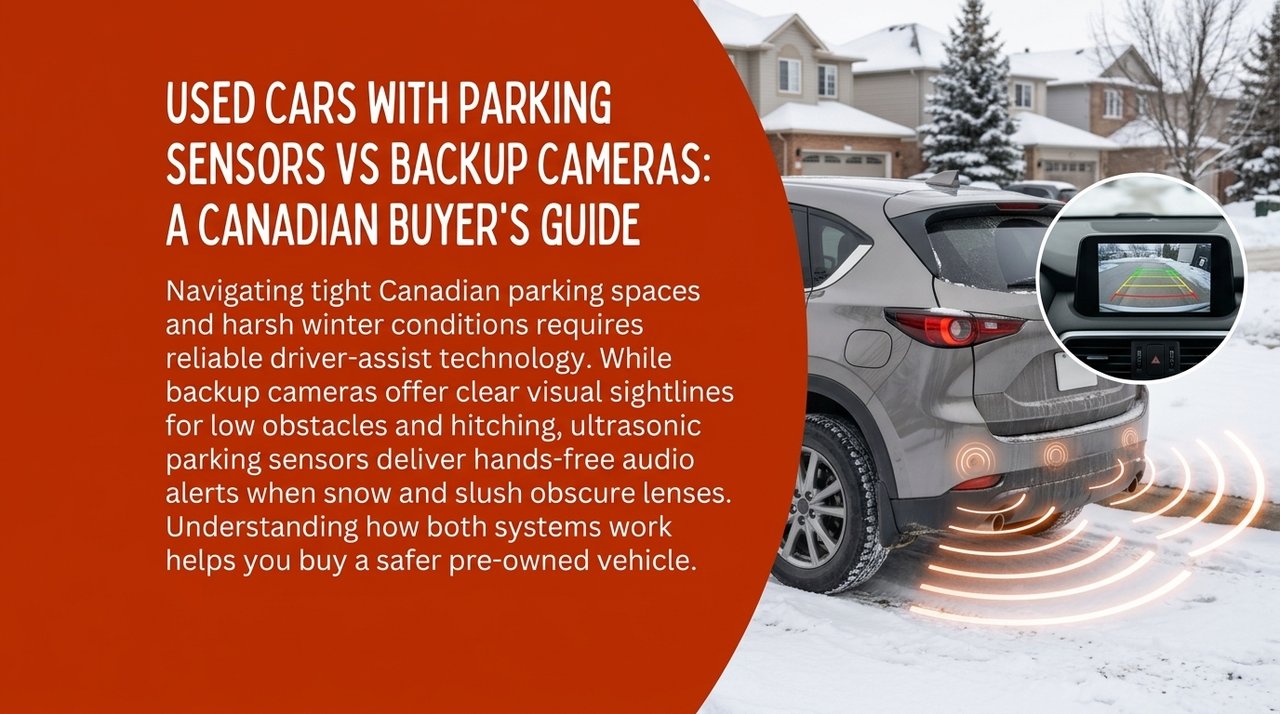
New drivers who have tested using backup cameras and parking sensors in the city or wedged a truck into the underground parking lot of a downtown Toronto condo building know that driver-assist tech isn't a novel concept. Before Transport Canada's rear-visibility requirements came into effect in 2018, cameras and sonar arrays were either optional upgrades often associated with higher trim levels, or standalone aftermarket features that came with a hefty premium. From that date forward, new light-duty vehicles were required to be equipped with a rear-view camera as standard equipment.
The more you know about what's behind the sheet metal, the better you'll understand how the systems behave as the cars get older. That's especially true for a backup camera-which works with wide-angle lenses, typically between 130-180 degrees-and onboard CMOS image sensors that convert the light from objects in view into digital video signals fed to the dash. In newer installs, the image processing in the high-tech dash unit cuts out the fisheye distortion and superimposes steering-guide lines that reflect what's happening on the road, curve by curve.
Sonar sensor systems operate on an entirely different principle. Installed recessed and flush with your front or rear bumper fascias, tiny painted aluminum pucks are embedded with piezoelectric crystals. When the system is activated, the control module applies an electrical pulse (typically 40 to 48 kHz) to the crystal, causing the crystals to vibrate and emit sound waves that reflect off nearby objects and return to the sensors; the system calculates the sound waves' round-trip time of flight out to the target and back again; and converts the target's physical distance into a series of rapid radio beeps inside your vehicle. Where a camera gives you eyes behind your tailgate, sonar systems give you a cane.
With electromagnetic strips, the conventional circular cutouts in the bumper are replaced with a single strip of metallic foil tape stretched across the interior of the plastic bumper cover. This causes the bumper to be surrounded by a small electromagnetic field - when something solid disrupts the magnetic field, the chime goes off. The good: No cutouts means no pucks to fuss with. The bad: The electromagnetic parking sensors detect nearby objects through changes in the electromagnetic field; ultrasonic sensors can detect stationary objects that you're not moving toward.
In real-world applications, context is everything. A camera display can instantly show a driver any low-hanging obstacles within the sweep of an acoustic beam, such as concrete wheel stops, large potholes, a low brick wall, or toys left in a driveway. Additionally, cameras make hitching a trailer to a vehicle remotely simple, allowing a driver to reverse within millimeters of a coupler ball. For their part, sonar systems give the driver hands-free spatial awareness. With an active audio chime, the driver doesn't need to keep a finger on the display; instead, they can keep a foot on the brake, keep their head turning left and right to check the side mirrors, and use sound tones to know when the wall is near.
Canadian winter driving conditions can put considerable strain on vehicle safety systems and are often the definitive test for most driver-assist systems, especially lane-keep assist, adaptive cruise, and collision avoidance. Nothing's going to gouge sensors, wash out radar, or ruin optical lenses and acoustic transducers like Canada's harshest driving season.
Ultrasonic sensors use tiny vibrations in the aluminum diaphragms. When road salt brine, slush, and slush splashing onto the rear bumper while you are driving down the highway in southern Ontario in winter, that slurry dries into a crusty layer of salt. Even worse, as they freeze and thaw, tiny amounts of water bleed into the small rubber isolation grommet that surrounds each sensor. Once frozen, the diaphragms are held still by water that is no longer there, and the control module sees a stationary obstacle that's 0cm away and sends the 1000Hz screamer at you.
A quick heads-up if you are in the used cars with parking sensors market. Staying aware of legislative changes will save you time and reduce inspection issues. As of May 1, 2018, Transport Canada officially adopted CMVSS 111. Canadian Motor Vehicle Safety Standard (CMVSS) 111 requires all light-duty passenger vehicles (<4,536 kg GVWR) to establish a valid rear visibility system. CMVSS 111 states that, in reverse mode, the system should display a 3 m x 6 m field of view within 0.5 seconds.
This is a big day for used cars with parking sensors. For cars built after May 1, 2018, the backup camera isn't a bonus feature; it's a safety feature. And under provincial safety standard certification requirements (Ontario's Safety Standard Certificate, for example, or British Columbia's provincial inspection regulations), you automatically fail your safety inspection to change ownership and register plates if you buy a vehicle that has a manufacturer-installed camera from the last four years that's either not working or not present.
Along the bumper cover, examine each sensor puck; make sure the rubber rings are still there, the face of the puck is flush with the bumper skin, and there are no added layers of touch-up paint or aftermarket clearcoat, which may have been applied in a thick enough coat that it changes the sensor's resonant frequency and causes persistent false alerts. Have a friend walk toward each rear corner bumper with a large sheet of cardboard and listen for the audio chime to accelerate in pitch; a continuous tone generally indicates that the object is within approximately 25 cm of the bumper. Repeat this test for each puck.
With the system energized in Reverse (engine off, parking brake set), touch your finger to the face of each operating sensor puck. A functioning ultrasonic sensor may produce faint clicking sounds is a series of faint, rapid clicks when you hold your finger to the face of the puck. If it's totally dead, you'll know that particular transducer is failing, or the wiring circuit is.
If you're buying an older vehicle (pre-2018) that doesn't yet have factory technology but want it, an aftermarket upgrade is a cost-effective way. Simple aftermarket acoustic sensor kits usually fall in the $150 CAD to $450 CAD range per kit (installed), often requiring a 22mm hole to be drilled in your plastic bumper cover and taking power directly from the reverse light circuit. Wireless or wired license plate camera kits generally range from $200 CAD to $600 CAD (including installation). Basic safety kits are essentially just a tailgate camera, but full packages include front parking sensors and a multi-channel rear parking-assist network. Knowing how they work is the key to avoiding being mystified by a parking aid on the back of the vehicle.
Front sensors rely on a different set of criteria. Automatic activation when you shift into Reverse remains unchanged, sweeping up to 1.8 m behind the vehicle. However, front sonar sensors are arranged in a narrower envelope – typically 0.8-1.0 m wide – and automatically shut off once vehicle speed reaches approximately 10-15 km/h, signaled by the CAN bus network, so as not to become distracting when you're cruising on the highway. Wind and rain, or heavy road spray, are causing false sensitivity. A dashboard-mounted manual override switch (optional for high-trim models) cancels the audible chime when you're idling in drive-thru lanes or inching through bumper-to-bumper traffic behind large trucks.
With leases for model years 2020-2024 turning over in the secondary market, the distinction between passive driver alerts and active collision mitigation is further blurred. Advanced sensor fusion design integrates acoustic array transducers, a wide-angle camera, and short-range millimeter-wave radar sensors into a single converged central processing module. This multi-sensor design enables active safety features such as Rear Automatic Emergency Braking (R-AEB). While the driver is still hearing warning horns and urging the car to stop reversing, the central module activates the hydraulic brake actuator and brings the vehicle to a halt.
The second, frequently-seen pre-owned addition is the all-around-view video camera system. That 360-degree view system takes the images from its four wide-angle video camera lenses-one in the nose, one under the side mirrors, one on the inside edge of the tailgate-and feeds them to the central computer, which seamlessly stitches the images into a single top-down view of the entire car you see on the infotainment screen. When paired with Automated Parking Assist (APA), the system can identify suitable parallel or perpendicular parking spaces and help steer the vehicle into them, modern parking systems can virtually eliminate parking-lot stress.
Are vehicles with parking sensors safer than those equipped with just a backup camera?
These two technologies complement each other, creating a combined system that is among the safest available. A camera system can provide the driver with fine-grained visual details of what's happening behind the car, so they can see precisely what objects, curb corners, pets, or children are lingering below the visual horizon. Sensors provide ongoing audible warnings when you get too close as you glance in the side mirror.
Is it possible to retrofit front parking sensors onto an older car?
Sure, you can retrofit the front acoustic sensors to an older vehicle. Canadian professional automotive accessory dealerships and retailers sell universal and model-specific aftermarket kits. These contain four front-bumper pucks, a central controller connected to the vehicle's speed sensor or foot-brake circuit, and a dash-mounted chime or LED indicator. Professional installation typically costs $250-$600 CAD, depending on the vehicle's front fascia contours and paint-matching needs.
Why do parking sensors beep continuously in freezing weather?
During Canadian winters, frequent false alarms usually occur because ice bridging or packed snow covers the sensor's puck face. Ultrasonic transducers send ultrasonic sound waves out by rapidly vibrating an aluminum diaphragm. Water trapped in the rubber decoupling ring around the puck can freeze, immobilizing the diaphragm. The control computer interprets the immobility as an object in contact at 0cm. Cleaning off ice, salt crust, and snow with a gloved hand will almost always cure the problem immediately.
What are the main backup camera benefits during Canadian winters?
Even the strongest LED backup camera flashlights won't be enough when confronting roadways filled with dark ambient light. Fortunately, the high-sensitivity CMOS sensors in your backup camera can help you make sense of low-visibility roadways, such as snow-plowed neighborhoods with no outdoor lighting or a muddy basement parking lot.
Is rear parking assist standard on all post-2018 Canadian vehicles?
No. Even though it came into law on May 1, 2018, most mid- and lower-range economy vehicles still offer optional acoustic rear parking assist. Transport Canada only requires visual coverage zones and screen instant response, not acoustic sonar patterns. Therefore, you'll find many used two-year-old vehicles with a rear camera but no acoustic proximity pucks unless they were explicitly ordered as part of a premium package.
How do I check parking sensors before I buy?
Engage the parking brake, turn the key to ON (be sure the engine is not started yet), and place the gear shifter in Reverse. Ask a helper to walk toward each sensor puck holding the cardboard box, and watch the chime rate change. To test individual pucks directly, simply place your fingertip on the face of the sensor- an operational ultrasonic transducer puck will deliver a tiny, rapid mechanical vibratory pulse to your finger.
The pre-owned auto industry in Canada is a balancing act between budget, feature convenience, and internal motor reliability. Driver-assist features have transitioned from elitist gadgetry to crash protectors of car owners' bank accounts against the damage of low-speed parking accidents. When comparing visual cameras and acoustic proximity networks, understanding how they perform in typical Canadian driving conditions can help you choose with confidence.
Optical backup cameras provide obvious visual cues. They help you identify curbs and piles of snow hazards, attach trailers without a helper, and reverse out of closed parking garage spaces into oncoming traffic. But optical glass is susceptible to salt spray, disgusting slush, and thermal shock on those extended winter outings. Acoustic parking sensors-whether front parking sensors or full-blown rear parking assistance arrays-are the ideal complement. These ultrasonic transducers bounce high-pitched sound waves off objects and provide easy-to-hear, hands-free acoustic distance alerts for use at night, in fog, and in cold conditions.
For those purchasing in Canada, this is a pre-owned vehicle equipped with both technologies. The visual camera feed gives you immediate hazard context, while the active distance monitoring of the acoustic sonar network keeps your eyes on your environment. Static inspections, sensor vibration pulse validation, control module flash scanning for diagnostic trouble codes, and a Canadian compliance assessment to Transport Canada's CMVSS 111 standard are the minimum steps for a pre-owned vehicle that delivers convenience, safety, and long-term resale value.
The Canadian Guide to Buying Used Cars with Apple CarPlay and Android Auto
Buying a used vehicle today involves more than a test drive and a quick inspection of the engine bay and undercarriage, not to mention checking the...
Read more
Used Cars with Heated Steering Wheel: A Practical Guide to Winter Driving Comfort
Calgary doesn't have to be tough when the temperature is cold, the roads are icy, and you are waiting for your car to warm up in the morning. By...
Read more
Are Used Cars with Remote Start Worth It in Calgary
If you've ever stood outside on a January morning in Calgary when temperatures drop to -30°C, scraping a rock-hard sheet of ice off your windshield...
Read morePowered and developed by
