Key Insights
- A basic engine inspection – including the color of the oil, looking for leaks, checking the belts, and listening for odd noises – should be done before you even start the engine.
- Don't forget to check transmission, brake, and power steering fluid levels; discolored or burnt fluid usually means maintenance is long overdue or a larger issue is developing.
- Look under a car for structural rust, particularly on the frame and undercarriage components. Superficial rust on the body panels is usually less of a concern.
- Run the vehicle's VIN through Transport Canada's recall database, as a CarFax report typically does not list open recalls.
- For EVs and hybrids, additional inspection areas include battery health, charging capability, regenerative braking response, and the status of the 12V auxiliary battery.
- The test drive checklist is crucial; various aspects of a car's performance will reveal themselves at cold start, during highway driving, and under heavy braking.
- A mechanic's inspection is essential and costs $100-$200 CAD; be wary of any seller who refuses this step.
- Finalize your purchase decisions after carefully compiling all the information obtained from your inspection.
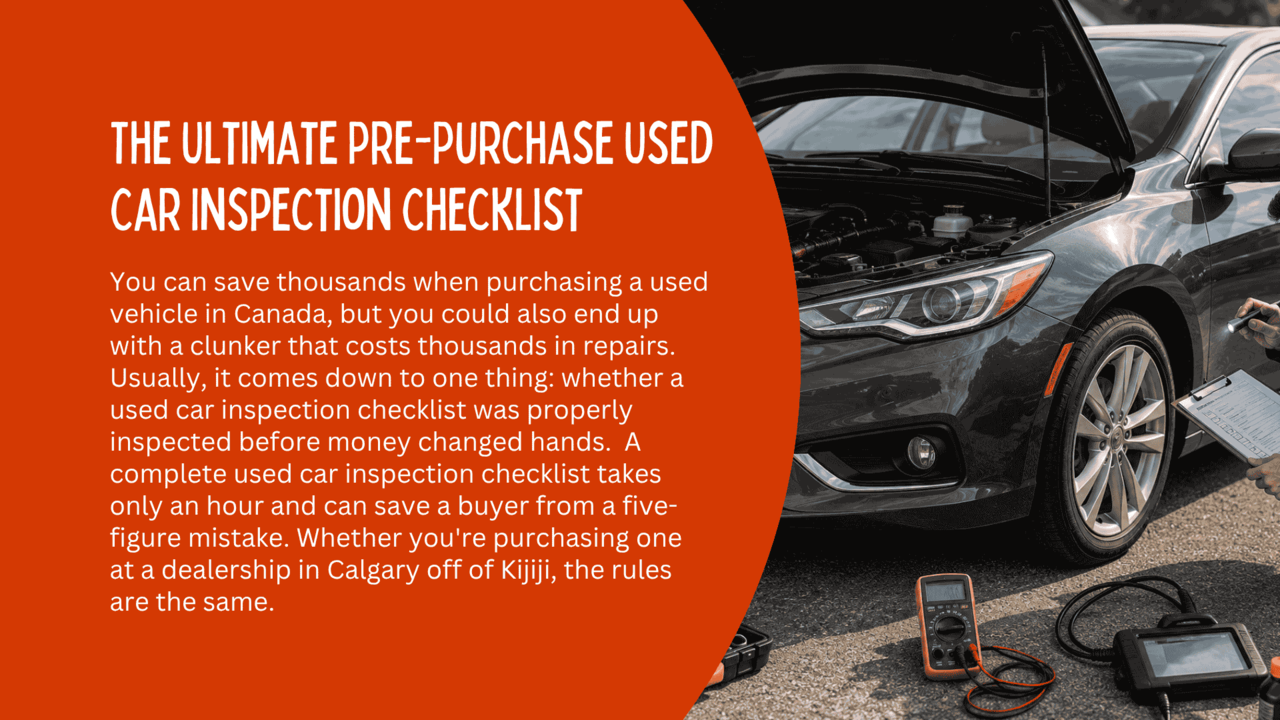
You can save thousands when purchasing a used vehicle in Canada, but you could also end up with a clunker that costs thousands in repairs. Usually, it comes down to one thing: whether a used car inspection checklist was properly inspected before money changed hands. A complete used car inspection checklist takes only an hour and can save a buyer from a five-figure mistake. Whether you're purchasing one at a dealership in Calgary off of Kijiji, the rules are the same. Here's exactly what you need to be checking before signing on the dotted line:
Why You Need a Used Car Inspection Checklist
Both private and dealership sellers will want to present the car's best features. This is normal practice, but it leaves the buyer to discover flaws. A used car inspection checklist provides repeatable tasks so you can avoid getting distracted by glossy paint or an amazing sound system while missing a cracked engine mount or bald tires.
Step 1: Do Your Research (Before Viewing the Car)
- Do your homework first, then schedule a viewing.
- Use CarFax Canada or CARPROOF to identify any recorded accidents, salvage titles, or odometer issues.
- Check what similar vehicles are priced at in your region on AutoTrader or Kijiji Autos.
- Ensure the VIN on the ownership, dashboard tag, and sticker in the driver-side door jamb match.
- Ask about any available service records; someone with records for past oil changes and general upkeep is likely a more detail-oriented owner.
- Verify the presence of any recalls.
- A used car inspection checklist history report will not always account for open safety recalls – enter the vehicle’s VIN into Transport Canada’s recall database to check for any relevant outstanding repairs.
- Initial due diligence can significantly narrow down your choice of vehicle and will help you walk into the inspection ready to notice any issues.
Step 2: Walk-around of the Exterior
- Take a thorough walk-around of the vehicle in daylight and on level ground. Don’t do any inspections in the rain or during the evening – both can easily obscure minor defects.
- Examine panel gaps and paint color matching. Uneven panels or differing paint colors can indicate that the car was previously in an accident.
- Look closely for signs of rust. Pay attention to the rocker panels, wheel wells, under the doors, and inside the trunk floor – vital especially for vehicles that have been owned and operated during winters within Quebec, Ontario, or the Maritimes.
Tire Condition is More Telling Than You Think
- A car’s tires indicate how the car was driven and maintained. Uneven tread wear can be a signal of improper alignment, worn-out suspension parts, or bent wheels-all of which get expensive quickly.
- Use the penny test or a tread depth gauge to determine whether enough tread remains (at least 4-5 mm is advisable).
Look for wear across the tires asymmetrically-feathering, cupping, or wear that's concentrated to one edge of the tread.
- Ensure that all four tires are the same brand and size. Mismatched tires may indicate budget repairs or hidden alignment issues.
- Check for your spare tire, a jack, and tools.
- Make sure to examine tire manufacture dates-a four-digit number stamped on the sidewall (e.g., 1221 means the tire was manufactured in the 12th week of 2021). Replace tires more than six years old, regardless of tread depth.
Frame and Undercarriage Rust: What to Specifically Look Out For
- While a bit of surface rust on cosmetic body panels is no cause for alarm, rust on the car’s structure is a whole other story, and the single greatest risk factor in a Canadian used car inspection checklist. When the car is up on a lift (or before you can get under with a flashlight), specifically look out for:
- Frame rails and subframe-scaling, bubbling, or texture with flakes is not good. It means the structural integrity has been compromised.
- Brake and fuel lines-these steel lines that run underneath the vehicle are vulnerable to rust holes, which can result in a sudden brake failure or a fuel leak.
- Rocker panels and floor pans-press down on them and see if you feel any soft or crumbly spots; it signals the metal beneath is completely gone.
- Suspension mounting points-rust here will loosen control arm and strut mounting bolts over time.
- Exhaust-this is a cheaper part to fix than, say, a corroded frame rail, but any severe rust on the muffler or exhaust pipes is worth noting.
- Any rust on a structural component that’s loose or flaking orange-brown scales, or actually perforated (has holes), is a good reason to keep walking.
Step 3: Under the Hood - Engine Inspection Basics
- You don’t need to be a professional mechanic to pick out obvious red flags under the hood.
- Check the dipstick. The oil should be amber to dark brown, not milky (meaning coolant in the oil) or gritty.
- Ideally, start the car from cold. Strange noises, poor starting, and excessive exhaust smoke on startup are bad because a warm engine masks underlying issues.
- Listen to the car with the engine on-any ticking, knocking, or whining noise often means trouble with timing equipment, bearings, or the alternator.
- A clean engine bay looks appealing, although it could also signify that the seller had the engine detailed for you-so don’t let that convince you of a well-maintained car.
Transmission, Brake, and Power Steering Fluid Checks
- Beyond engine oil and coolant, many other fluids are often overlooked and can provide just as much information about the car.
- Automatic Transmission Fluid-with the engine warmed and idling (check the owner’s manual, as some modern transmissions have no dipstick and will require a mechanic to read). The fluid should be pink to bright red and have no burning smell. If it’s cloudy or dark with a burnt aroma, then a repair is likely in your future.
- Manual Transmission Fluid-difficult to check with a dipstick and often requires a fill plug to be removed. The best indicator of wear here is during your drive: grinding sounds, a clutch that engages too high, or notchiness in the shifter.
- Brake Fluid-check the level of the brake fluid under the hood. It should look clear to lightly amber. Dark brown or black fluid has absorbed moisture and dirt and doesn’t perform optimally.
Power Steering Fluid-if the vehicle has hydraulic power steering, ensure the level is appropriate and the fluid is clean. Noises while turning at low speeds might suggest it’s running on too low or degraded fluids.
Step 4: Inside the Cabin
- Before you take the car for a spin, sit inside and do this:
- Test all windows, locks, seat adjustment buttons, and heated seats/mirrors.
Test the backup camera, infotainment system, and monitor for any warning lights on the dashboard.
- Turn the ignition to the “on” position (without starting) and confirm all warning lights briefly illuminate and then go off once the engine begins to run (a dashboard warning light remaining on-especially the check engine light-needs further investigation).
- Smell for mildew or strong odors that could signal water leaks and damage to the vehicle.
- Compare the miles on the odometer to the car's age and any records you've collected.
Step 5: The Test Drive Checklist
- Accelerate-the car should run smoothly and without hesitation or excessive engine noise.
- Brake firmly (on an open stretch of road)-make sure it pulls straight, without vibration and with sufficient force.
Test the steering-there should be no looseness or shimmy in the wheel.
- Drive over a speed bump and listen for thuds or bouncing.
- Check performance at highway speeds-there should be no vibration and smooth passing performance.
- Test your parking and reversing skills, and ensure backup cameras and parking sensors (if equipped) engage correctly.
- Adjust climate control-check the A/C and the heat to their max settings.
Don't shy away from any seller who refuses to let you do a thorough test drive.
Purchasing a Pre-Owned Electric or Hybrid: Key Differences
- Battery health/state of health (SOH): Ask the seller for a battery health report. This can sometimes be generated by the manufacturer's app or by the dealership. A drastically degraded battery will mean a shorter range and the eventual need for expensive battery servicing.
- Charging performance: Whenever possible, try to plug the car into an outlet during your inspection. You want to make sure that it charges correctly, not just on a standard outlet, but ideally on a Level 2 charger as well.
- Regenerative braking experience: While test driving, pay close attention to how the regenerative braking feels. It should be smooth and predictable, not jerky or delayed in its response.
- Special warning lights for the hybrid/EV system: These warning lights sometimes look different from a typical engine warning light. Note any unfamiliar lights on your dashboard and have them inspected.
- 12-volt auxiliary battery: Even electric and hybrid vehicles rely on a small 12-volt battery that powers your accessories and startup electronics; if it’s weak, you might run into various seemingly unrelated electrical issues.
- Battery pack's cooling system: Many EVs use liquid thermal management for the battery pack, so ask whether the cooling system has ever required maintenance.
- Since repairs to EV and hybrid drivetrains are more expensive to handle outside of warranty, getting a professional mechanic who specializes in EVs/hybrids to inspect the car can be extremely beneficial – especially because not all general mechanics have the right diagnostic equipment.
Step 6: Have a Professional Mechanic Inspect the Vehicle
- Although you’ll need to set aside a little cash-$100 to $200 CAD-for the most accurate assessment of a vehicle, you can rely on a certified mechanic for more than DIY car care. Arrange your own Pre-Purchase Inspection (PPI) with a mechanic at Canadian Tire, NAPA AUTOPRO, or your favorite local shop before the handshake.
- A mechanic's pre-purchase inspection typically involves:
- Inspection of the undercarriage, frame, and exhaust system using a lift
- Diagnostic scanning of the vehicle's computer for stored trouble codes
- Measurement of the condition of the brake pads and rotors
- Examination of suspension and steering components
- Testing of the charging system and battery health
- Fluid analysis, which goes beyond a simple visual check
- If a private seller refuses to let an independent mechanic inspect the vehicle, it's a major red flag, and you should reconsider the purchase.
Step 7: Make a Final Assessment Before You Commit
- When the walkaround, engine check, drive, and assessment are finished, take time to reconcile and assess one final time.
- Use the estimated repair costs you've obtained (if any) to negotiate a better price, comparing them against the asking price.
- Confirm the ownership documents are in order, check for any liens on the vehicle, and understand the provincial requirements for safety certificates (e.g., a Safety Standards Certificate is mandatory for resale in Ontario). You can also use general used car inspection checklist advice from the Canadian Automobile Association and compare it with your province's rules.
- Get quotes from insurance companies to ensure the cost of insuring the vehicle fits within your budget, as some vehicles can be unexpectedly expensive to insure.
- Be sure you know the particulars of used-car warranty laws in your province, which can differ greatly between buying from a private seller versus a dealership.
Frequently Asked Questions
How much does a pre-purchase inspection (PPI) generally cost in Canada?
Most independent shops, along with chains like Canadian Tire or NAPA AUTOPRO, will typically charge between $100 and $200 CAD for a standard PPI. The exact fee will depend on the shop, its location, and the extent of the inspection-a quick visual check versus a full mechanical assessment with diagnostic scanning, for example.
During an inspection, what should I specifically look for under a car?
Pay close attention to the condition of the frame rails, subframe, rocker panels, and floor pans. Look for corrosion, focusing on flaking or crumbly rust, which indicates a more serious structural issue than simple surface oxidation. Examine the brake and fuel lines for any corrosion and look for fluid leaks, such as oil, transmission fluid, or coolant, under the vehicle. Also, inspect the mounting points of the exhaust system and suspension components.
Beyond a CarFax report, is there any other way to detect flood or lemon history?
While a CarFax report is an excellent starting point, it doesn't always catch everything. Smell for a musty odor, check under the carpets, in the spare tire well in the trunk, and around the door sills and dashboard for signs of water damage or excessive rust. The mechanic's PPI can also sometimes identify signs of flood damage based on patterns of corrosion that wouldn't appear on a report.
Do I need to check for recalls separately from the CarFax report?
Yes. CarFax reports focus on accident, title, and odometer history, and do not reliably show open manufacturer recalls. It is crucial to check the VIN directly through Transport Canada's recalls database to see whether any unrepaired safety recalls are outstanding for the vehicle.
Is a used EV or hybrid inspection different from a gas car inspection?
Yes, additional checks are required. In addition to all the standard inspections done on a gas-powered car, you'll need to request a battery health report, test the charging performance, and assess the feel of regenerative braking. In contrast, when driving, ensure the 12V auxiliary battery and battery cooling system don't have a history of issues.
Conclusion
Buying a used car inspection checklist shouldn't be an endeavor shrouded in uncertainty. With a methodical used car inspection checklist in hand, you'll be well-equipped to approach any vehicle viewing with the confidence that comes from knowing what to scrutinize-from the condition of its tires to the noise it makes in the engine bay during a test drive. Combine a detailed self-inspection with an expert mechanic's assessment, and you'll significantly reduce your chances of encountering costly repairs down the line. Taking the time and adhering to the process will serve you well and save you a significant amount of money in the long run.